Best Fishing Spots in Texas: Five Famous Lakes and the Exact Place to Fish on Each
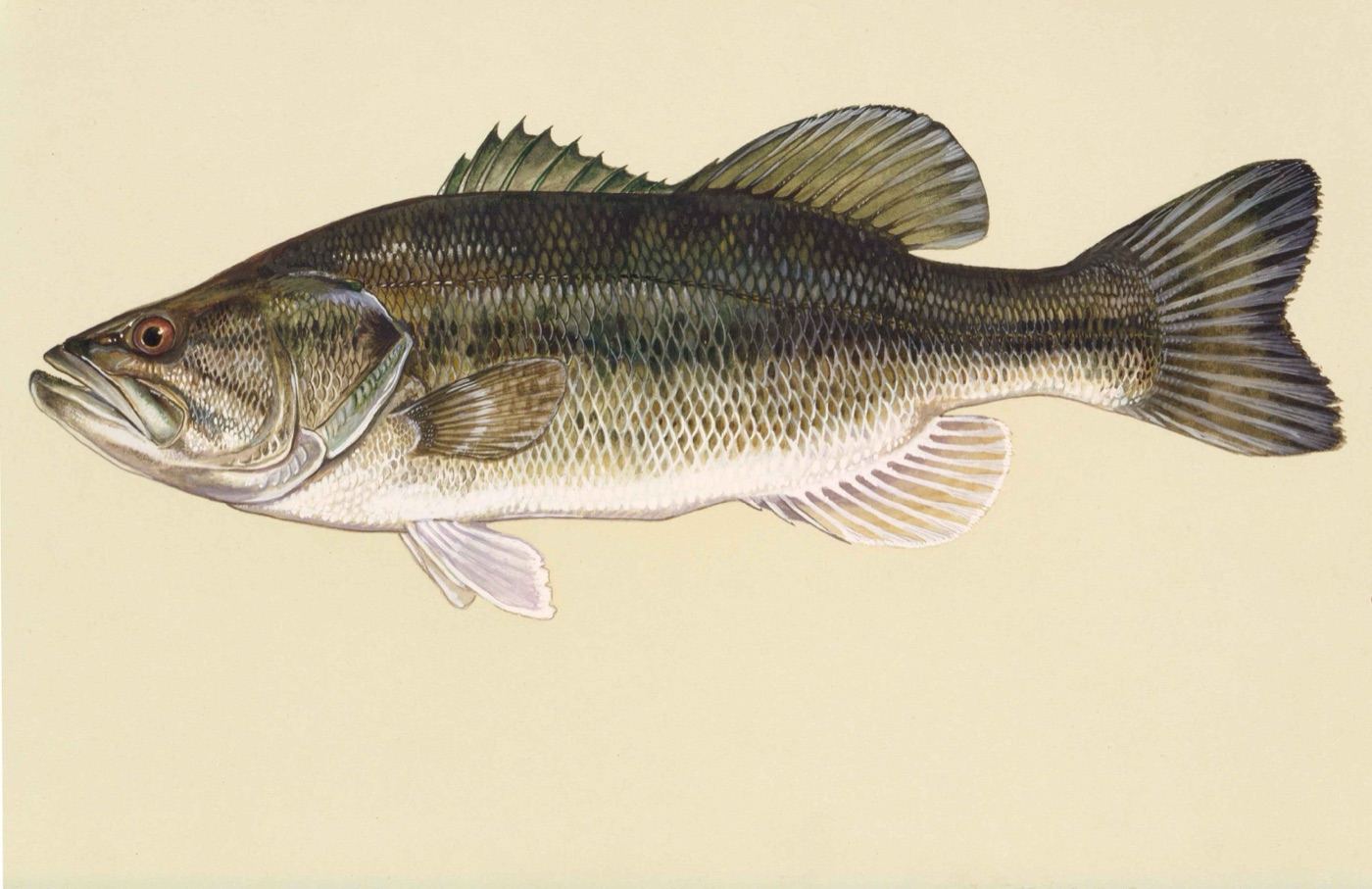
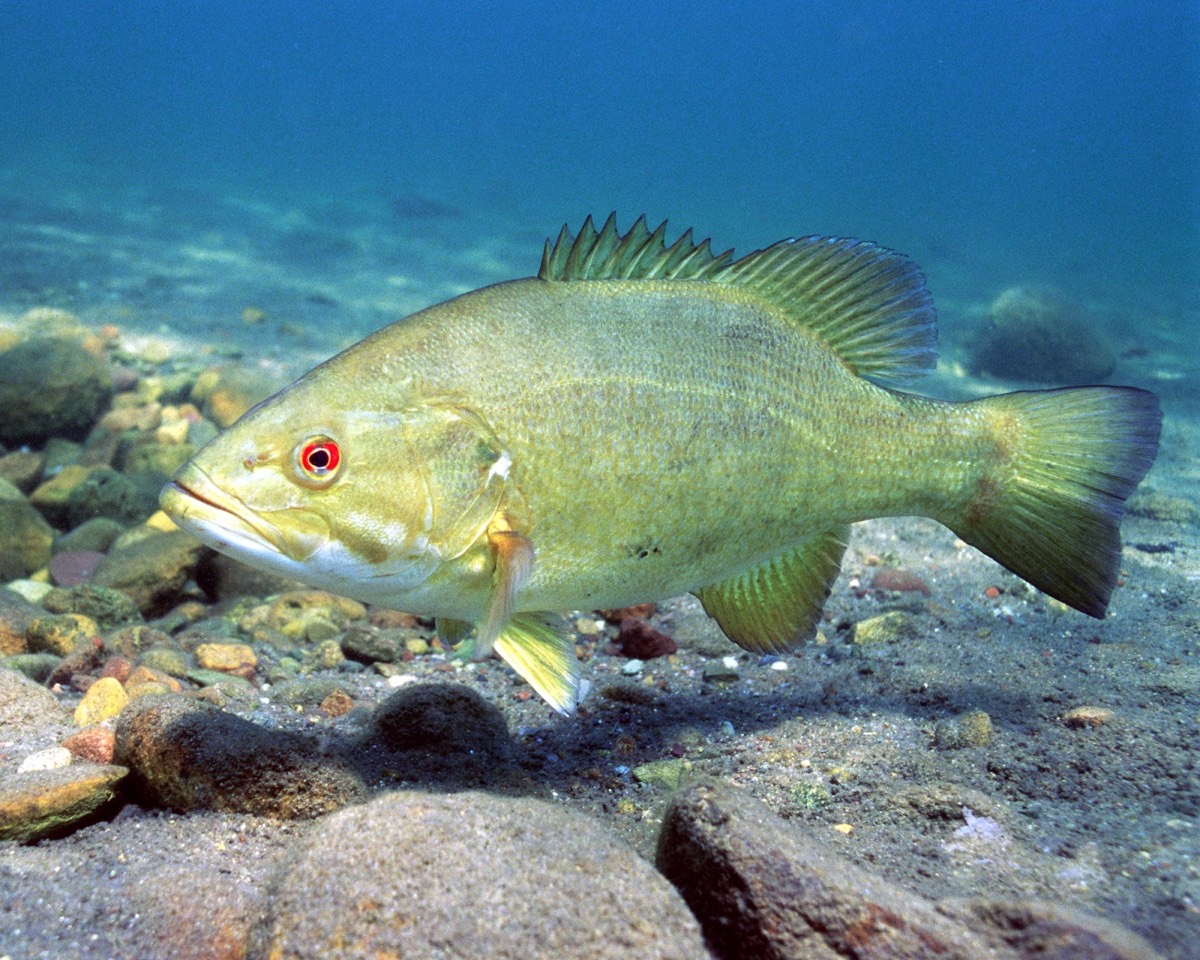
Five Texas lakes the state's own fisheries agency rates excellent for at least one species, each with a pinpoint you can drive to: the FM 515 bridge on Lake Fork, Mill Creek Park on Sam Rayburn, Eisenhower State Park on Lake Texoma, Falcon State Park on Falcon Lake and Governor's Landing on Amistad. Largemouth bass lead on four; Texoma is the state's striped and smallmouth bass water.
Key takeaways
- Texas Parks and Wildlife rates largemouth bass excellent on Lake Fork, Sam Rayburn, Falcon and Amistad, and striped and smallmouth bass excellent on Lake Texoma.
- TPWD says more than 65% of the Texas Top 50 largest bass, including the state record, came from Lake Fork.
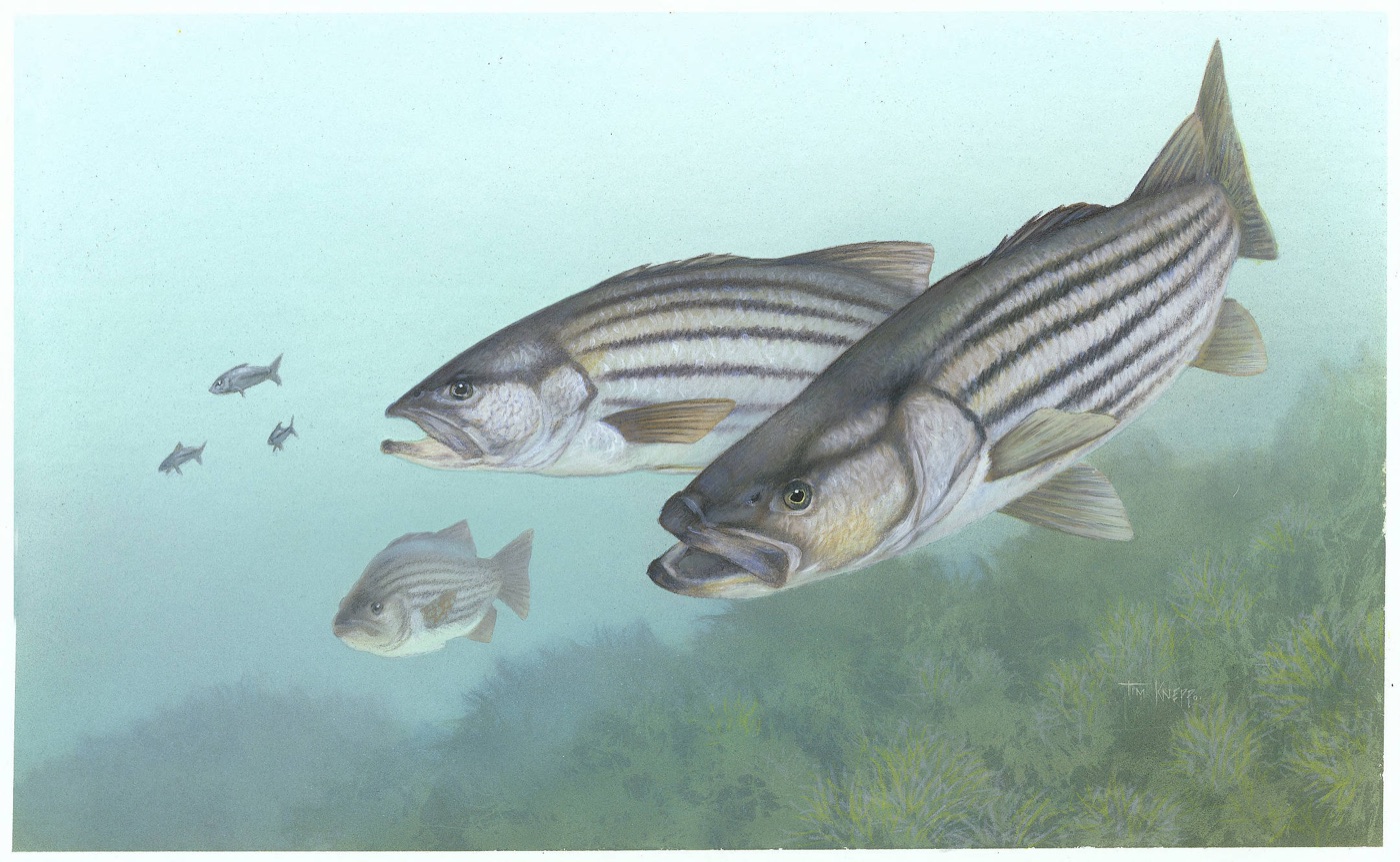
- Texoma is one of the few US freshwater lakes with a self-sustaining striped bass population, per TPWD — the other dozen Texas striper lakes need stocking.
- Each pin is a place the agency names: the bridges TPWD lists for Lake Fork crappie, the Eisenhower State Park bluffs it names for Texoma smallmouth, the Governor's Landing habitat on Amistad.
- TPWD states that no licence is needed to fish from shore inside a Texas state park — two of the five pins are in state parks.
How these five were chosen
Texas Parks and Wildlife publishes a fishing profile for every major lake in the state, and each one rates its sport fish from poor to excellent, names the cover the fish use and describes what works by season. Those profiles are the whole basis of this page. A lake made the list if TPWD rates at least one species excellent there and the agency — or the federal agency that manages the shoreline — names a specific public place we could put a pin on.
That second test is the strict one, and it is why Toledo Bend and Lake Conroe, both excellent bass lakes by TPWD’s own rating, are not here: their profiles describe the fishing but name no single public spot to start from.
| # | Pinpoint | Lake | TPWD rates excellent | Access |
|---|---|---|---|---|
| 1 | FM 515 bridge | Lake Fork | Largemouth bass, catfish | Boat |
| 2 | Mill Creek Park | Sam Rayburn | Largemouth bass, catfish, crappie | Corps park + ramp |
| 3 | Eisenhower State Park | Lake Texoma | Smallmouth bass, striped bass, blue catfish | Piers, shore, ramp |
| 4 | Falcon State Park | Falcon Lake | Largemouth bass, catfish | Shore, ramp |
| 5 | Governor’s Landing | Amistad | Largemouth bass | Shore, ramp |
On licences, TPWD’s beginners’ page is the short version: Texas anglers need one unless they are under 17 or fishing in a state park, and the Eisenhower and Falcon park pages both state that no licence is required to fish from shore inside a Texas state park. Everything else — limits, special lake regulations, border rules — is linked under each lake.
Lake Fork — FM 515 bridge
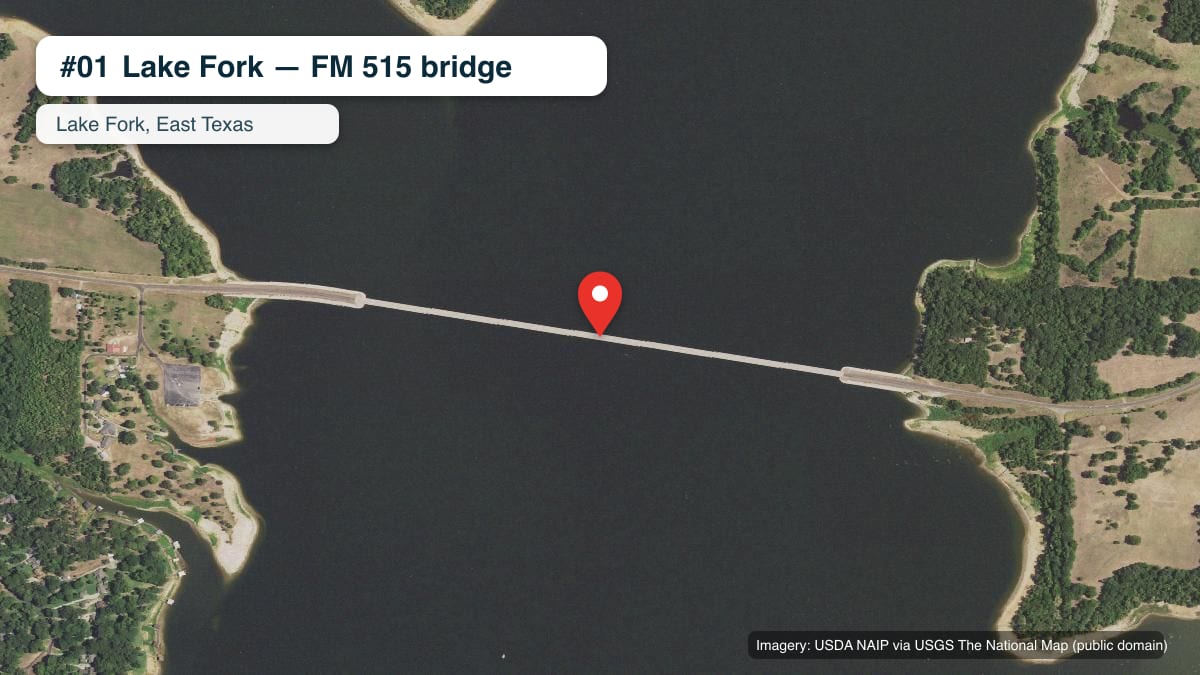
Why it is on the list. TPWD calls Lake Fork one of the country’s premier trophy bass lakes, and gives the evidence: restrictive harvest rules, stocking of Florida-strain largemouth and abundant habitat have produced more than 65% of the Texas Top 50 largest bass, including the current state record, and more than half of the fish entered in the agency’s ShareLunker programme. The 27,264-acre reservoir on the Sabine River lies about five miles northwest of Quitman.
Why this exact spot. The bridges are the one place on Lake Fork the agency names outright. TPWD’s tactics section says that in late spring and early fall most crappie anglers fish under the bridges — Highway 154, Highway 515, County Road 2946 and County Road 514 — and its cover notes add that largemouth bass congregate around bridge pilings and artificial brush piles. The pin sits on the FM 515 crossing.
Target fish (TPWD rating). Largemouth bass — excellent · catfish — excellent · crappie — good · sunfish — good · white bass — fair.
Techniques, season by season.
- Spring (mid-February to April): bass are on the shoreline spawning; TPWD lists spinnerbaits, plastic worms and lizards, jigs and lipless crankbaits as the popular lures.
- Summer: night fishing “can be very productive” in TPWD’s words — plastic worms, spinnerbaits, crankbaits and topwaters. Late summer into early fall, schooling fish hit crankbaits and topwater.
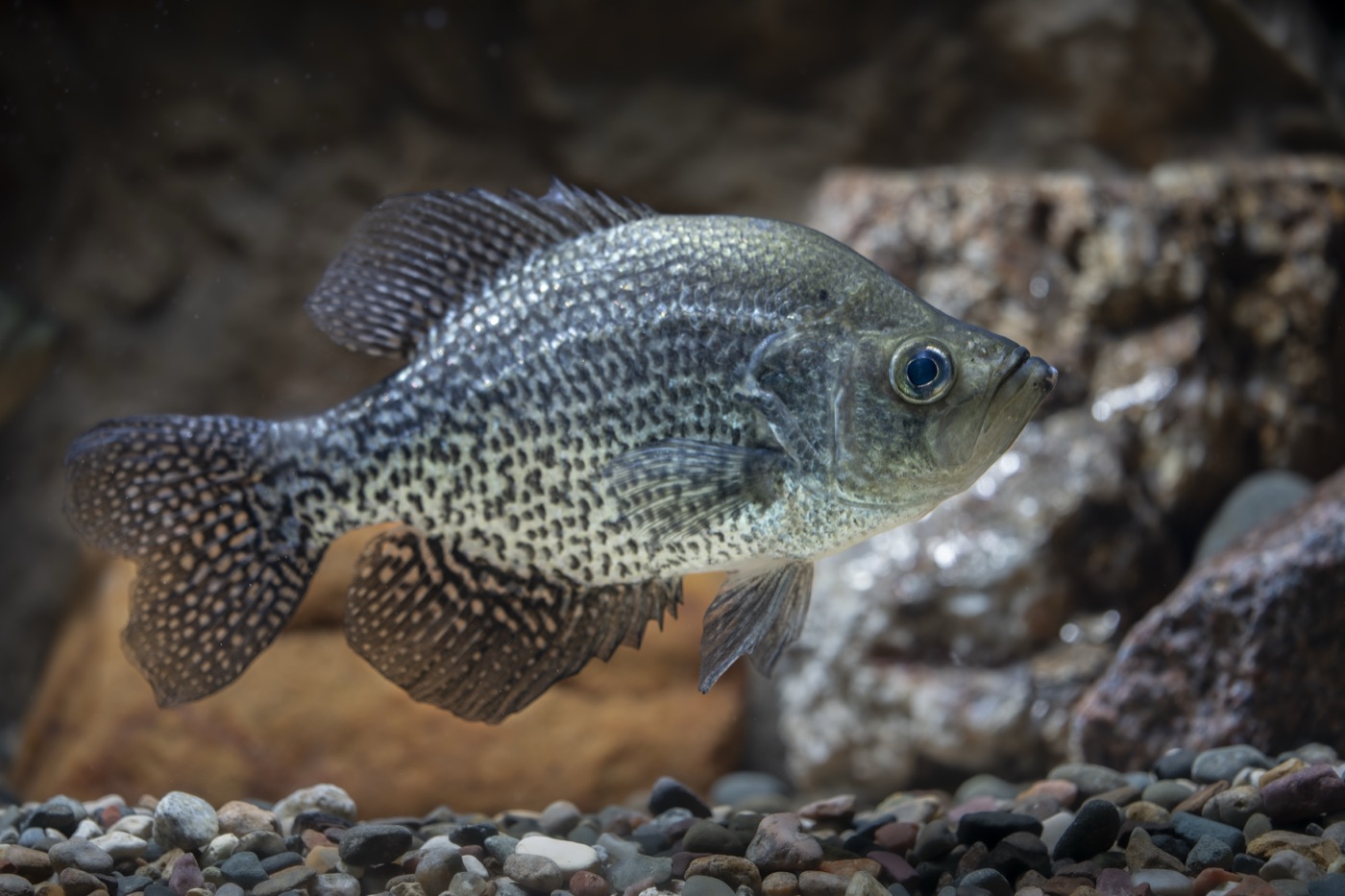
- Fall and late spring: crappie under the bridges on live minnows and crappie jigs.
- Winter: crappie move to deep water near the dam; bass take jigging spoons, jigs and crankbaits.
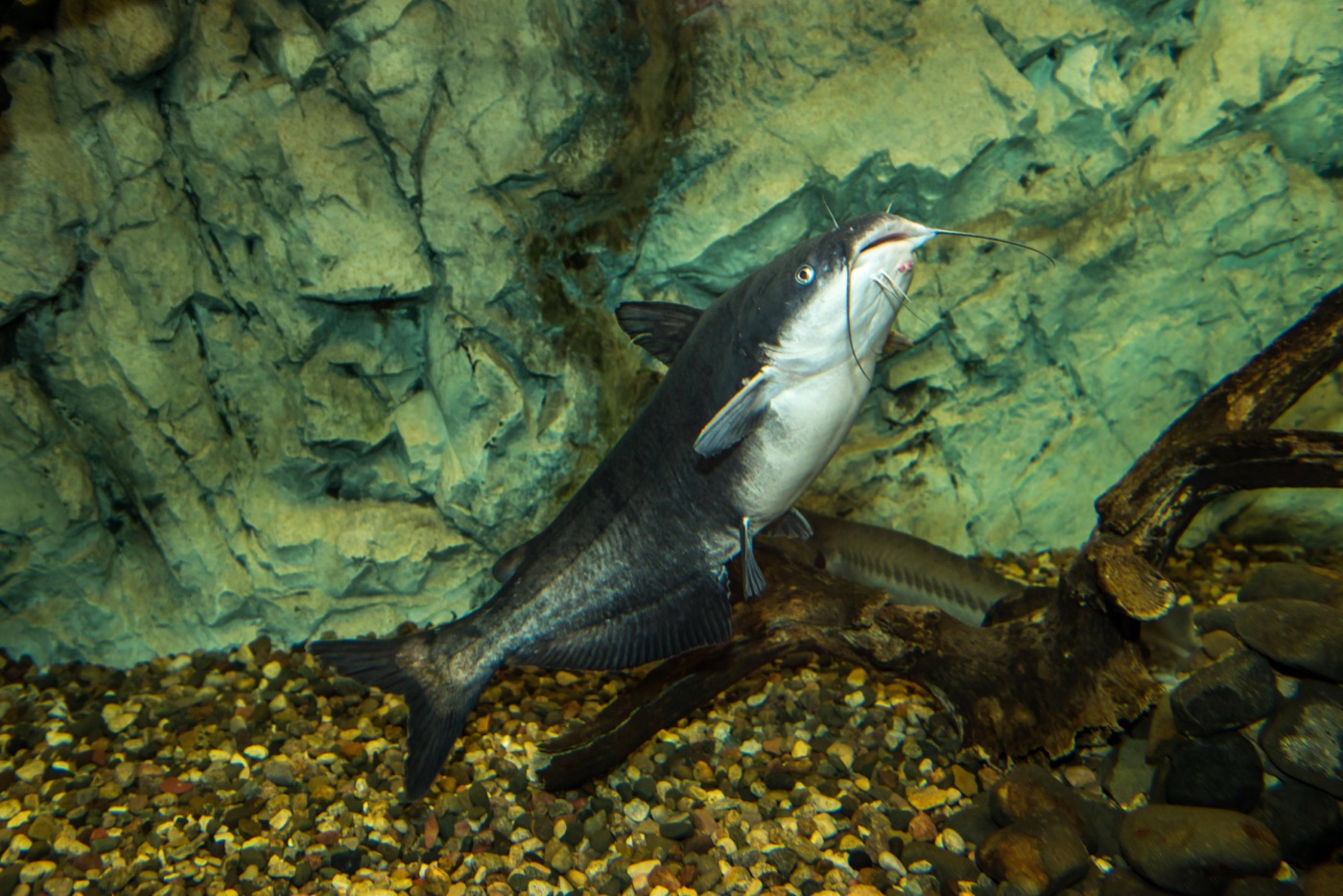
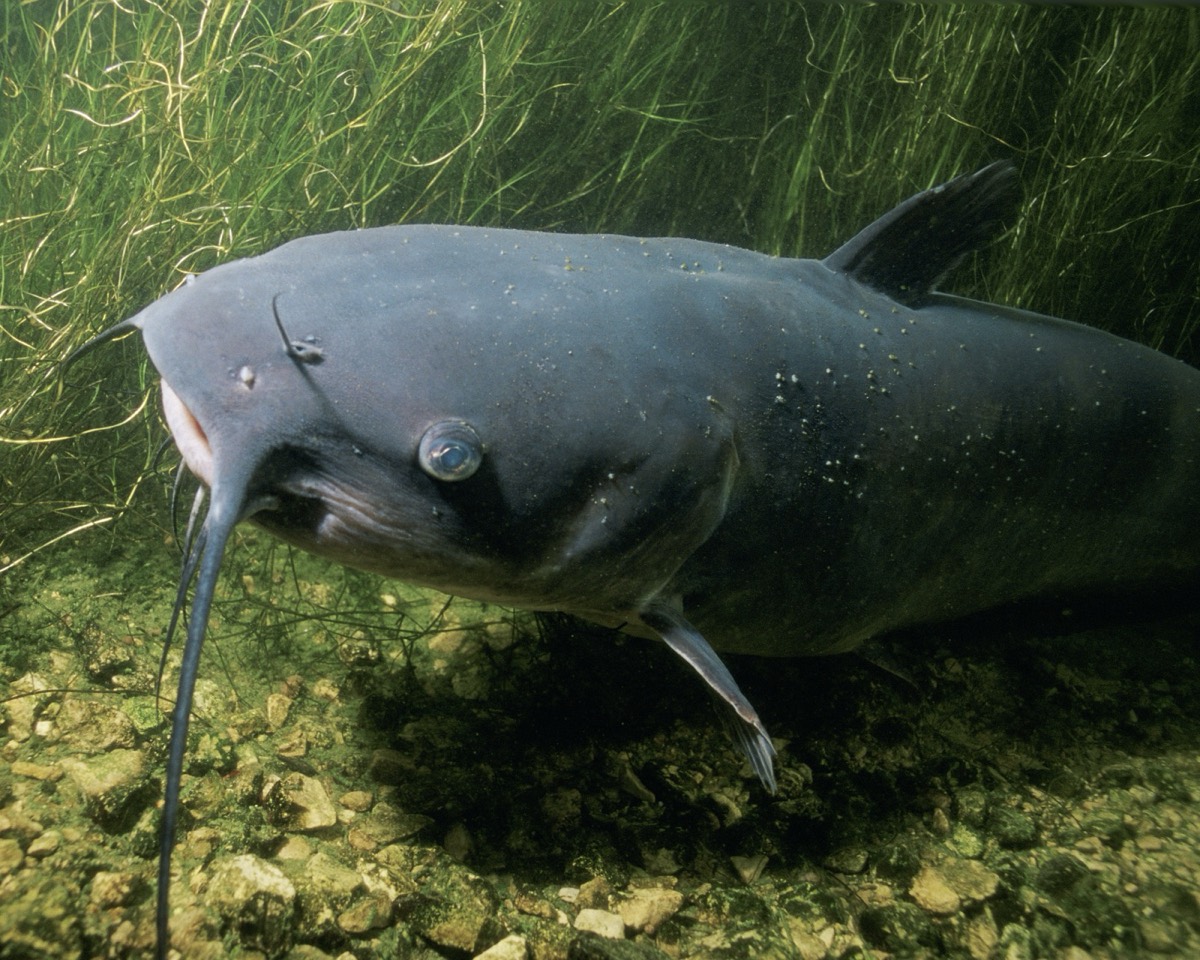
- Catfish, all year: stinkbait and cutbait for channels, live bait for flatheads.
Mind the timber. TPWD warns that submerged timber is a substantial boating hazard everywhere outside the buoyed boat lanes. Lake Fork carries special regulations on some species — read them on the agency’s page before you keep anything. Our largemouth bass and crappie fishing guides cover the fish.
Sam Rayburn — Mill Creek Park
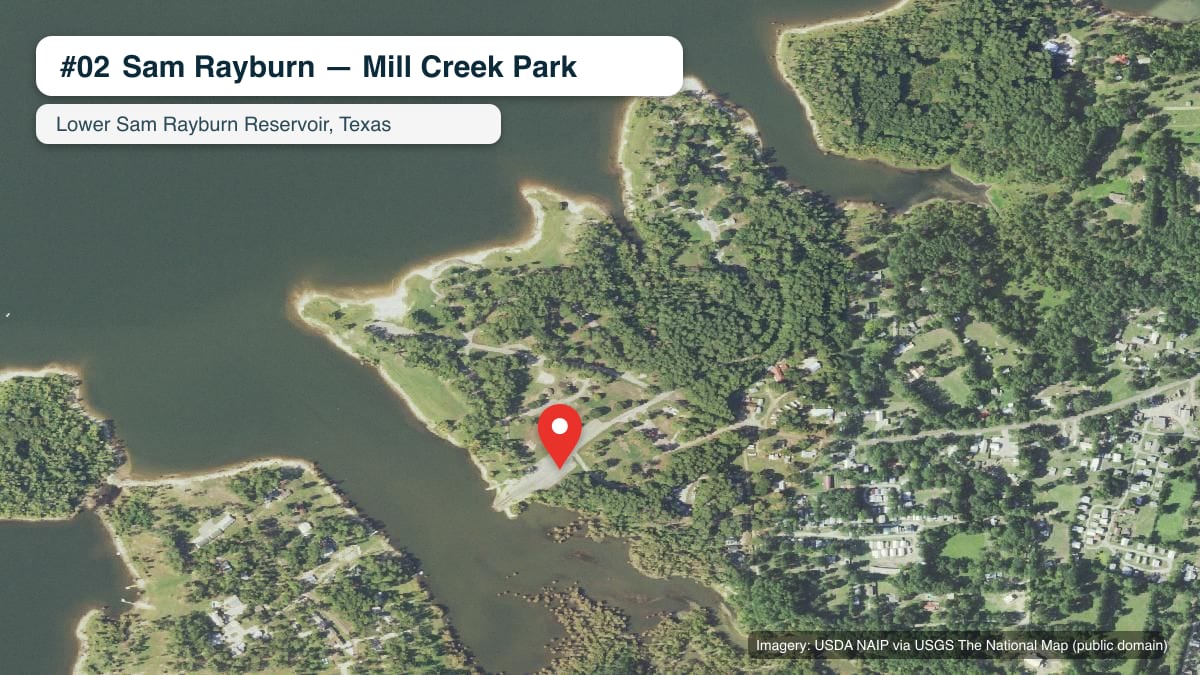
Why it is on the list. At 114,500 acres, Sam Rayburn is the biggest water on this list, and TPWD rates three of its species excellent: largemouth bass, catfish and crappie. The agency describes an excellent year-round bass fishery and excellent year-round crappie and catfish.
Why this exact spot. Mill Creek Park is one of the U.S. Army Corps of Engineers parks on the reservoir, on the lower lake near the dam. That matters because TPWD splits the lake in two: in the lower part the water is relatively clear and game fish are typically found around vegetation edges, flats, humps and creek channels; in the upper third, vegetation thins and timber, brush and laydowns take over. Launching at Mill Creek puts you in the clear-water half.
Target fish (TPWD rating). Largemouth bass — excellent · catfish — excellent · crappie — excellent · sunfish — good · white bass — fair.
Techniques, season by season.
- Fall, winter, spring: fish are active longer and sit shallow; TPWD names crankbaits and spinnerbaits as the usual choices.
- Summer: the bite concentrates at dawn, dusk and night. Topwater in low light; once the sun is up, bass move to vegetation edges and brush piles or drop to deep ledges and creek channels — plastic worms, jigs and Carolina rigs.
- Crappie, all year: jigs and minnows. Shallow vegetation during the spring spawn, deeper brush piles and creek channels the rest of the year.
TPWD notes that Rayburn’s level fluctuates about seven feet a year and that drastic changes alter the vegetation; at high water, flooded trees and bushes become excellent habitat. A fish consumption advisory is in effect — the agency links it from the lake page. Our Texas and Carolina rigs guide covers the two rigs TPWD names.
Lake Texoma — Eisenhower State Park
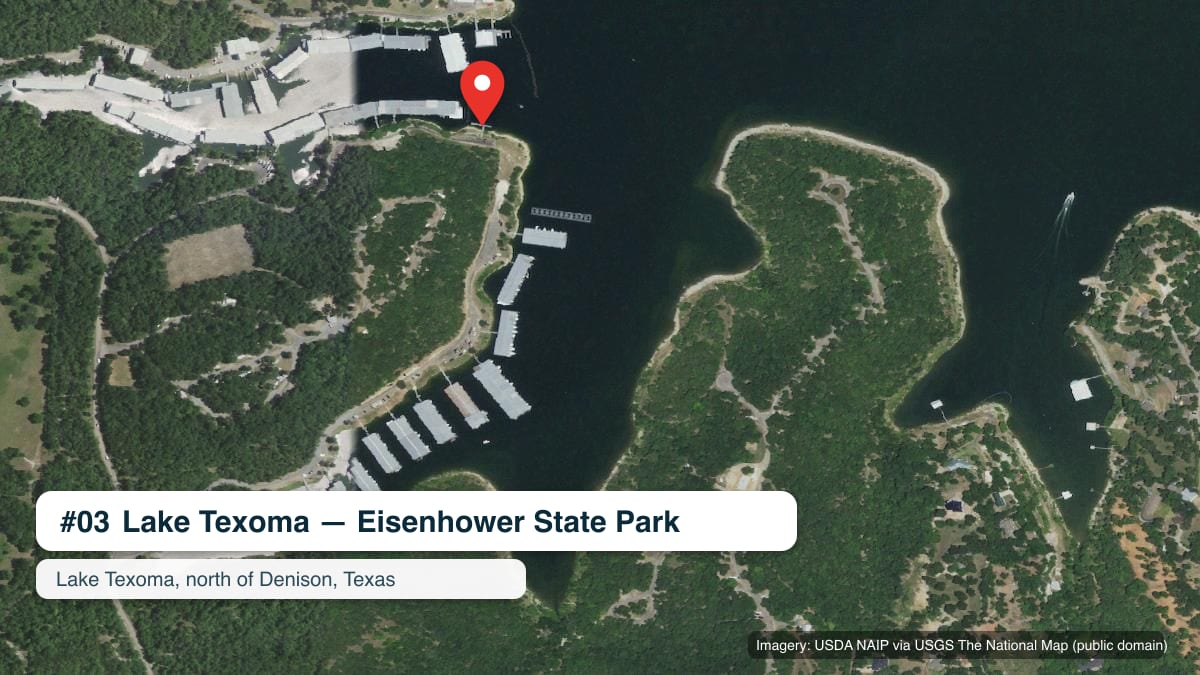
Why it is on the list. Texoma is the striper lake. TPWD explains that flows from the Red and Washita rivers make it one of the few freshwater lakes in the United States with a self-sustaining, landlocked striped bass population — a dozen other Texas lakes have stripers only because they are stocked. The agency rates striped bass, smallmouth bass and blue catfish excellent, and the current Texas state-record blue catfish, 121.5 pounds, came from Texoma in 2004.
Why this exact spot. TPWD names it twice. Its tactics section says smallmouth bass are mostly limited to the bluffs around Eisenhower State Park, Denison Dam and the Washita arm, and it suggests fishing at night by the bluffs near the park. The park’s own page adds two fishing piers — one lighted for night fishing — shoreline access, a fish cleaning station and a boat ramp, and lists stripers, crappie and catfish as the targets.
Target fish (TPWD rating). Smallmouth bass — excellent · striped bass — excellent · blue catfish — excellent · largemouth and spotted bass — good · channel catfish — good · crappie — good · white bass — good · flathead catfish — fair.
Techniques, season by season.
- February: stripers run up both river arms and hold near the river channel around the Willis and Roosevelt bridges — heavy jigs, slabs, plastic shad and live gizzard shad.
- After the spawn: stripers on shad over flats near the river channel in the main lake; trolling deep-running lures also works.
- Summer, fall, winter: watch for gulls diving on surfacing stripers feeding on threadfin shad — topwater and fast-retrieved plastic shad.
- Smallmouth: free-lined live threadfin shad off the dam rip-rap, or at night by the bluffs near the park.
- Catfish: channels near creek mouths after rain in spring and fall, and around rip-rap in late spring; TPWD’s baits are shrimp, blood bait, cut bait, dough bait and shad gizzards, and drifting shrimp across flats in summer. Blue catfish on live shad on windless winter days.
- Crappie: best in fall and winter around boat houses, submerged trees, creek channels and brush piles.
Two-thirds of Texoma lies in Oklahoma. TPWD explains that a Texas licence covers the Texas side and that a separate Lake Texoma licence covers the whole lake; the lakewide limits are on its page. Drain boats, livewells and bait buckets before you leave — the agency’s invasive-species rule. Our striped bass and smallmouth bass pages cover the fish.
Falcon Lake — Falcon State Park
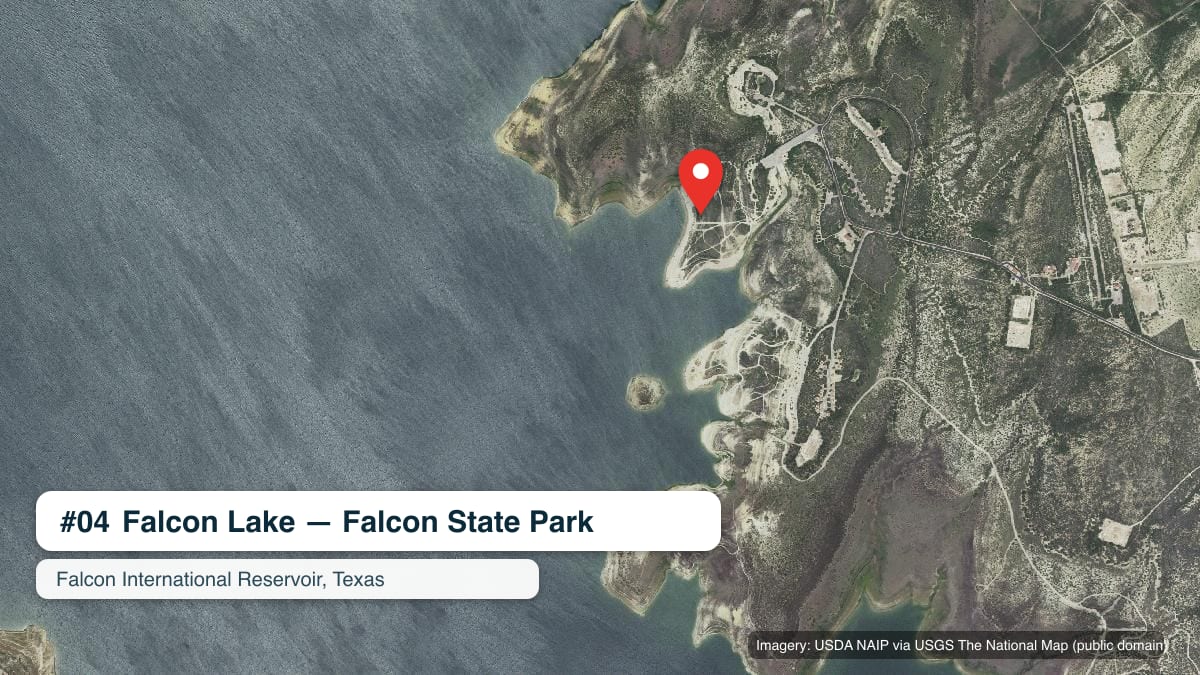
Why it is on the list. TPWD says Falcon “has long been regarded as one of the best largemouth bass lakes in the state,” and puts a number on it: winning a bass tournament there often takes a five- to six-pound average per fish. The reservoir on the Rio Grande, about 40 miles east of Laredo, covers 83,654 acres at conservation pool.
Why this exact spot. Falcon State Park is the public front door. TPWD’s park page describes anglers coming “to access one of the best freshwater fishing lakes in South Texas,” mainly for largemouth bass and channel catfish, with a boat ramp, a fish cleaning station and shore fishing that needs no licence inside the park.
Target fish (TPWD rating). Largemouth bass — excellent · catfish — excellent · crappie — poor · white bass — poor. The agency is candid that drought has hurt the white bass and crappie.
Techniques, season by season.
- Spring, fall, winter: the productive months. TPWD’s baits are spinnerbaits, crankbaits and Texas- and Carolina-rigged worms, fished around flooded brush, points and offshore structure — humps, rock piles, inundated buildings and road beds.
- Summer: tough, partly because of the South Texas heat; the same lures plus topwater and buzzbaits early and late.
- Catfish, any time of year: stinkbaits or natural baits such as shad, shrimp or sunfish.
Read the level before you go. TPWD lists Falcon’s fluctuation as severe — 40 to 50 feet or more — and notes that at low water, rock piles and standing timber are most of the structure, while at full pool, terrestrial vegetation provides excellent cover. Mexican waters need a Mexican licence for everyone in the boat.
Amistad — Governor’s Landing
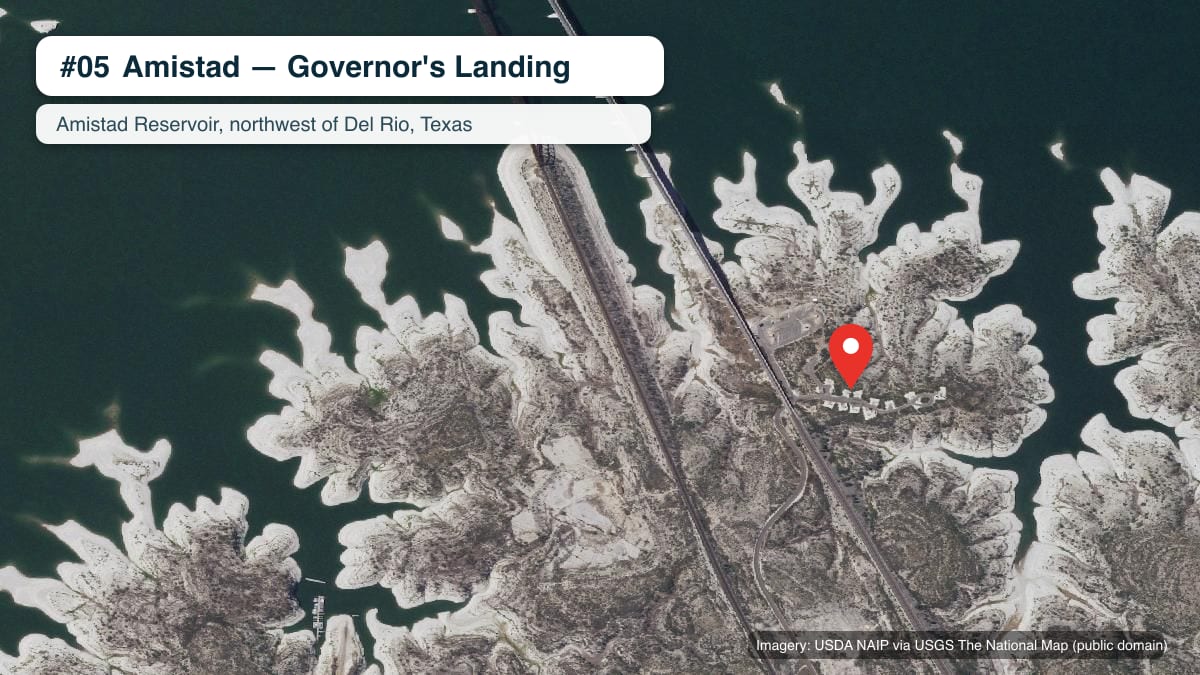
Why it is on the list. Clear water, rock everywhere, and largemouth bass rated excellent by TPWD, which calls them the most popular and most abundant sport fish in the reservoir. Stocked striped bass and spring runs of white bass round it out, and smallmouth bass are present, with anglers reporting better success in the Devils River arm.
Why this exact spot. TPWD notes that it worked with local organisations to place a Christmas-tree fish habitat near the Governor’s Landing camping area, at the US 90 crossing northwest of Del Rio — a named, placed structure in a lake that is otherwise all natural rock. The National Park Service, which runs Amistad National Recreation Area, adds that you may fish from shore anywhere outside harbours and designated swim areas.
Target fish (TPWD rating). Largemouth bass — excellent · channel and blue catfish — good · white and striped bass — good · smallmouth bass — fair.
Techniques, season by season.
- Fall, winter, spring: the bass months. Topwater, buzzbaits and spinnerbaits early and late; crankbaits along rocky shorelines, points and drop-offs.
- Midday: Texas- and Carolina-rigged worms and grubs fished deeper near vegetation or rock.
- Late January through March: white bass run up the rivers to spawn — lipless rattle baits, jigging spoons and minnows.
- Catfish: stinkbait and cutbait for channels and blues throughout the lake.
Amistad is dominated by rock ledges, steep drop-offs and rocky points, in TPWD’s description. The border with Mexico runs along the main channel and is marked by numbered buoys; the NPS explains that Texas rules apply on the US side and Mexico’s in Mexican waters. Fish cleaning stations are at Diablo East, Pecos and Rough Canyon — the park asks that fish remains never go in the lake.
Before you go
Check the water level. Every one of these lakes fluctuates, and on Falcon and Amistad the swing can rewrite the map. TPWD links the current level from each lake page.
Read the lake’s regulations. Lake Fork, Sam Rayburn and Texoma carry special limits on some species, and border rules apply on Texoma, Falcon and Amistad. The agency pages linked above are the only source worth trusting — our licences and regulations guide explains where Texas publishes them.
Pick the day. The tactics above are seasonal; the day-to-day bite still follows weather, pressure and light. Our best time to fish and barometric pressure pages cover why, and our night fishing guide is worth reading before a Texas summer trip, since TPWD recommends it on two of these lakes.
What it cannot do
- Ratings, species and tactics are TPWD's published lake profiles, which are updated on the agency's schedule, not ours. Water levels — Falcon's can swing 40 to 50 feet — change what any of this means on a given day.
- Bag and size limits differ lake by lake and several of these lakes have special regulations. They are linked, never restated here.
- Toledo Bend, Lake Conroe and many other first-class Texas lakes are not on this list because TPWD's pages name no specific public spot on them we could pin. Absence here is not a ranking.
- Falcon and Amistad sit on the Mexican border and Texoma on the Oklahoma line; licence rules change at the boundary. The agencies explain how.
Frequently asked questions
What is the best fishing lake in Texas?
It depends on the fish, and Texas Parks and Wildlife's own lake profiles say so. For largemouth bass, TPWD rates Lake Fork, Sam Rayburn, Falcon and Amistad excellent, and calls Lake Fork one of the country's premier trophy bass lakes — more than 65% of the Texas Top 50 largest bass, including the current state record, came from it. For striped bass, Lake Texoma is the standout: TPWD describes it as one of the few freshwater lakes in the United States with a self-sustaining, landlocked striper population, and rates both stripers and smallmouth bass excellent there.
Where exactly should I fish on Lake Fork?
Start at the bridges. TPWD's Lake Fork page says that in late spring and early fall most anglers fish for crappie under the bridges — Highway 154, Highway 515, County Road 2946 and County Road 514 — using live minnows and crappie jigs, and that largemouth bass also congregate around bridge pilings and artificial brush piles. In winter, crappie move to deep water near the dam. For bass, TPWD names hydrilla, boat houses and docks, and lake points as historically the best areas, with spinnerbaits, plastic worms and lizards, jigs and lipless crankbaits popular during the mid-February to April spawn along the shoreline.
Do you need a fishing licence in Texas?
Generally yes, with two exceptions TPWD states directly. Its beginners' page says anglers in Texas need a fishing licence unless they are under 17 or fishing in a state park, and the Eisenhower and Falcon state park pages repeat that no licence is required to fish from shore inside a Texas state park. Fishing from a boat, or anywhere outside a state park, needs one. Border lakes add a layer: on Lake Texoma a Texas licence covers the Texas side, and on Falcon and Amistad a Mexican licence is required for everyone in the boat in Mexican waters.
When is the best time to fish Texas lakes for bass?
Fall, winter and spring, by TPWD's account on every bass lake on this list. On Sam Rayburn the agency explains why: in the cooler months fish are active for longer periods and typically sit in shallow water, while in the heat of summer the bite concentrates in early morning, late evening and at night. TPWD's Lake Fork page adds that night fishing in summer can be very productive and a good way to beat the heat, with plastic worms, spinnerbaits, crankbaits and topwaters.
Can you fish from the bank at these spots?
At three of them, clearly yes. Eisenhower State Park has two fishing piers — one lighted for night fishing — plus shoreline access and a fish cleaning station, according to TPWD. Falcon State Park offers shore fishing, a boat ramp and a cleaning station. On Amistad, the National Park Service says you may fish from shore anywhere outside harbours and designated swim areas. The Lake Fork bridges and Sam Rayburn's open-lake structure are primarily fished from boats; Mill Creek Park gives you the ramp and the bank around it.
Where is the best striped bass fishing in Texas?
Lake Texoma, by TPWD's description. Flows from the Red and Washita rivers let stripers reproduce naturally there, which TPWD says makes Texoma one of the few US freshwater lakes with a self-sustaining population; a dozen other Texas lakes hold stripers only through stocking. The agency's tactics: in February stripers run up both river arms and can usually be found near the Willis and Roosevelt bridges, taking heavy jigs, slabs, plastic shad and live gizzard shad; after the spawn, fish shad over flats near the river channel, and watch for gulls diving on surfacing schools in summer, fall and winter.
Sources
- Lake Fork Reservoir — fishing profile — Texas Parks and Wildlife Department. Accessed October 4, 2026.
- Sam Rayburn Reservoir — fishing profile — Texas Parks and Wildlife Department. Accessed October 4, 2026.
- Sam Rayburn Reservoir — Corps of Engineers parks — U.S. Army Corps of Engineers, Fort Worth District. Accessed October 4, 2026.
- Lake Texoma — fishing profile — Texas Parks and Wildlife Department. Accessed October 4, 2026.
- Eisenhower State Park — Texas Parks and Wildlife Department. Accessed October 4, 2026.
- Falcon International Reservoir — fishing profile — Texas Parks and Wildlife Department. Accessed October 4, 2026.
- Falcon State Park — Texas Parks and Wildlife Department. Accessed October 4, 2026.
- Amistad Reservoir — fishing profile — Texas Parks and Wildlife Department. Accessed October 4, 2026.
- Fishing — Amistad National Recreation Area — National Park Service. Accessed October 4, 2026.
- Fishing for Beginners — Texas Parks and Wildlife Department. Accessed October 4, 2026.
How we choose sources: sources policy.
More in this series
- Best Fishing Spots in Washington: Five Waters and the Exact Place to Fish on Each
- Best Fishing Spots in Wisconsin: Five Great Lakes Spots and When the Fish Run
- Best Fishing Spots in Arkansas: Five Waters and the Exact Place to Fish on Each
- Best Fishing Spots in Iowa: Five Lakes, the Exact Spot on Each and What Is Biting Now
Open the spot, then pick the day.
Fishing Club AI maps public fishing spots and turns live weather, pressure and moon data into a bite forecast for each one — so you know which of these to drive to this morning.
Get the App