Chain Pickerel
Esox niger
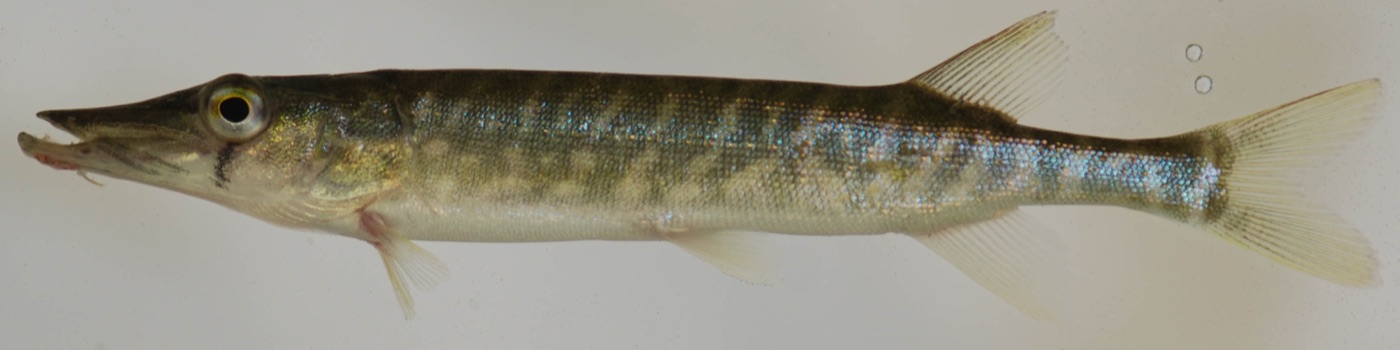
Chain pickerel is the pike family's ambush hunter of weedy shallows, named for the dark interconnecting lines along its flanks that resemble the links of a chain.
MoreFull Species Details
- Species Name
- Esox niger
- Family
- Esocidae
- Order
- Esociformes
- Also Known As
- Pickerel, Chainsides, Eastern pickerel
Chain Pickerel (Esox niger) Fish Description
Chain pickerel is the pike family's ambush hunter of weedy shallows, named for the dark interconnecting lines along its flanks that resemble the links of a chain.
The build is unmistakably pike: a long body, a duck-bill snout, and jaws that Maine's fisheries agency describes as elongated and containing large, sharp teeth. The name comes from the flank pattern — dark, interconnecting lines resembling the links of a chain over a lighter green-bronze ground. Telling a pickerel from a small northern pike is a cheek-and-chin exercise, and Maine's agency gives the keys: a pickerel's cheeks and gill covers are fully scaled, where a pike loses scales on the lower half of the gill cover, and a pickerel usually carries four pairs of sensory pores under the lower jaw to the pike's five. A dark vertical bar below the eye also separates it from a young muskellunge.
Chain pickerel are solitary ambush predators. North Carolina's agency describes them hiding in aquatic vegetation, waiting to ambush unsuspecting prey — a hunting style that keeps them in calm, weedy shallows, backwaters and lake margins. West Virginia adds small stream pools, abandoned channels and floodplain wetlands. The diet turns to fish early: by about four inches long, a young pickerel switches to eating mostly other fish. Spawning comes very early in spring, over vegetation, before most species have stirred. Where pike and pickerel share water, hybrids occur and can wear markings of either parent — worth remembering before calling a borderline fish.
Interesting Facts About Chain Pickerel
- The flank pattern — dark interconnecting lines like chain links — gives the species its name.
- It is a true member of the pike family, Esocidae.
- The jaws are elongated and carry large, sharp teeth.
- Fully scaled cheeks and gill covers separate it from a northern pike, whose lower gill cover is bare.
- Pickerel usually have four pairs of sensory pores under the jaw; pike usually five.
Show more facts
- The dark bar beneath the eye separates it from a young muskellunge, which lacks it.
- They are solitary ambush hunters that wait in vegetation rather than roam.
- By about four inches long, the diet switches to mostly fish.
- Spawning happens over vegetation in very early spring.
- Pike-pickerel hybrids occur and may show markings of either or both species.
- West Virginia finds them in stream pools, abandoned channels and floodplain wetlands.
- The West Virginia state record measured 27.87 inches and 6.19 pounds.
Average Speed & Size
Maine's agency puts a typical chain pickerel at 14 to 19 inches by age three to five — a fish measured in inches and single pounds, not the yardstick of its pike cousin. West Virginia's state record of 6.19 pounds and 27.87 inches marks the realistic ceiling; we do not quote a world record, as none survived source verification. The strike is the attraction: a pickerel hits a passing lure from cover with startling violence for its size, and its acceleration over the first metre is the whole show.
Where to Find Them
Find the thickest calm vegetation on the water and cast beside it. North Carolina's agency puts chain pickerel in relatively calm areas of lakes and rivers with abundant aquatic vegetation, and West Virginia extends the list to small stream pools, backwaters and floodplain wetlands. The fish are solitary, so each weed edge, pocket or downed tree tends to hold one ambusher rather than a school. Shallow margins fish well even in cold months — pickerel stay active in water that has shut other species down, and very early spring finds them shallowest of all, spawning over vegetation.
Chain Pickerel Fishing Tips
Pickerel fishing is casting at cover with something that flashes. The fish commits from ambush or not at all, so covering weed edges efficiently beats working any one spot slowly.
Equipment
A light to medium spinning outfit is ample for the fish — the teeth are the equipment problem. The jaws carry large, sharp teeth that abrade light line; many anglers add a short heavy leader. Long pliers for unhooking protect fingers from a thrashing, tooth-edged jaw.
Chumming
Not used. The fish's own ambush habit concentrates it for you: every likely piece of vegetation is a discrete target, and the strike answer arrives within a few casts.
Bait
Flash and movement draw ambush strikes: inline spinners, spoons and minnow-imitating plugs along weed edges are the classics. Live minnows under a float work where permitted. Retrieve past cover, not through open water.
Patience
Move rather than wait — a pickerel that saw the lure has already decided. Work a shoreline systematically, one weed pocket at a time, and return to productive cover later; ambush points get re-occupied. Handle every fish as if it bites, because it does.
Conditions that change the bite
- What Barometric Pressure Is Best for Fishing? No research supports a single best barometric pressure for fishing. What pressure really does, how big a weather swing is, and what to watch instead.
- Fishing After Rain: What Runoff Actually Changes Rain rewrites four things at once: clarity, flow, temperature and oxygen. What runoff actually does to the water, which fish it favors, and when to go back.
- Reading River Levels: Fishing by the Gauge More than 13,500 USGS streamgages report stage and flow in near real time. How to read gauge height, cfs and the hydrograph before you drive to the river.
Guides for fishing this species
- Fishing Line Types: Braid vs Mono vs Fluorocarbon Monofilament, fluorocarbon and braided line compared — stretch, visibility, sink rate and durability, what agencies actually say, and which to spool when.
Related Species
Know when they'll bite.
BiteScore forecasts when chain pickerel will feed at your spot — from live weather, pressure, and moon data.
Get the App