Wahoo
Acanthocybium solandri
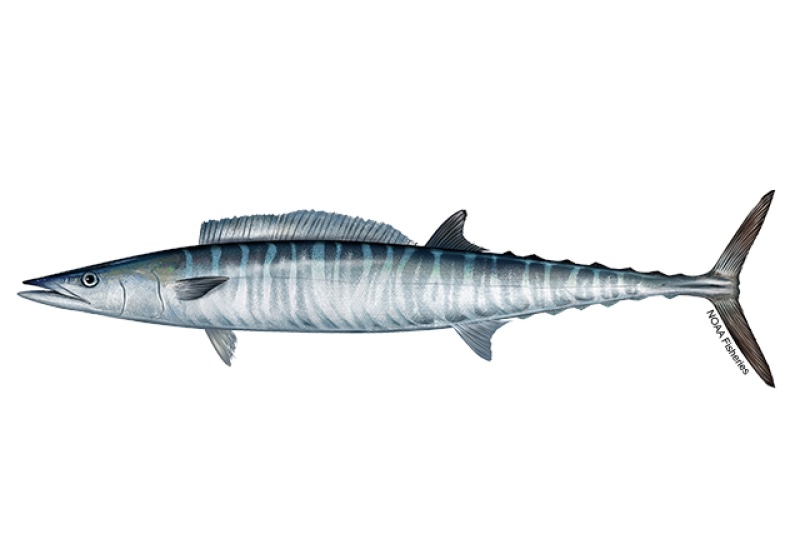
Wahoo is the loner of the mackerel family — a steel-blue open-ocean predator barred with 25 to 30 vertical stripes, hunting alone or in small groups rather than schools.
MoreFull Species Details
- Species Name
- Acanthocybium solandri
- Family
- Scombridae
- Order
- Perciformes
- Also Known As
- Ono, Peto, Kingfish
Wahoo (Acanthocybium solandri) Fish Description
Wahoo is the loner of the mackerel family — a steel-blue open-ocean predator barred with 25 to 30 vertical stripes, hunting alone or in small groups rather than schools.
The build is a blade: long, slender and steel blue above, pale blue below, crossed by what NOAA counts as 25 to 30 irregular blackish-blue vertical bars that flare vividly when the fish is excited and fade after death. The jaws carry teeth NOAA describes as strong, triangular, compressed and finely serrated — shear-cutting equipment that takes bait cleanly in half. Unlike its schooling relatives, the wahoo hunts by itself: NOAA notes the species is frequently found alone or in small, loosely connected groups, which is why wahoo come as sudden singles rather than as a bite.
Everything about the wahoo runs fast. NOAA gives a short lifespan of five or six years, maturity within the first year, and fecundity to match — a half-million to 45 million eggs per year across multiple spawns. The species is highly migratory in warm water worldwide; one tagged fish travelled 1,700 miles in six and a half months. That biology has a management consequence NOAA states directly: fast growth means wahoo can handle relatively high fishing rates, and the stocks, while unassessed, are managed with catch limits under the federal dolphin-wahoo plan, with recreational anglers holding most of the allocation. In Hawaii the fish is ono — and on the table, few fish anywhere outrank it.
Interesting Facts About Wahoo
- 25 to 30 irregular blackish-blue vertical bars cross the steel-blue body.
- The teeth are strong, triangular, compressed and finely serrated — built to shear.
- Wahoo hunt alone or in small, loose groups, not in compact schools.
- The lifespan is short — up to five or six years — with maturity at about age one.
- A female releases half a million to 45 million eggs a year over multiple spawns.
Show more facts
- One tagged wahoo travelled 1,700 miles in six and a half months.
- The diet is squid and fish, including frigate mackerel and butterfish.
- The Florida Museum records bursts up to about 75 km/h — roughly 47 mph.
- Fast growth lets the species sustain relatively high fishing rates, per NOAA.
- In Hawaii the wahoo is ono, and it ranks among the finest eating fish in the sea.
- Wahoo have been linked to ciguatera poisoning in some regions — a reason to know local advisories.
- US management runs through the federal Dolphin Wahoo plan from Maine to Florida.
Average Speed & Size
NOAA gives a typical wahoo at 3.3 to 5.4 feet, with a maximum up to 8 feet and 158 pounds; the Florida Museum's ceiling is 98 inches. Speed is the reputation, and honesty matters here: the 60-mph figure repeated everywhere has no verifiable source we could find. What is sourced is the Florida Museum's record of bursts up to about 75 kilometres per hour — roughly 47 mph — which is quite fast enough to explain the first run: a wahoo strike empties a reel at a rate nothing else its size matches, usually announced by a scream of drag and a bait cut clean.
Where to Find Them
Wahoo are open-ocean fish of warm water worldwide — in US terms, offshore of the South Atlantic, the Gulf, the Caribbean and Hawaii. NOAA associates them with banks, pinnacles and floating debris or weed lines: structure that organises the empty ocean and gathers the squid and small fish they hunt. Because the species travels alone or in small groups, wahoo fishing is trolling likely water rather than finding a school — edges of banks, colour changes, and anything floating deserve passes. High-speed trolling covers the search efficiently, matching a predator this fast.
Wahoo Fishing Tips
Wahoo fishing is a trolling game built around two facts: the fish is very fast, and its teeth cut everything. Speed finds the fish; wire keeps it connected.
Equipment
Heavy trolling gear with wire leader — the serrated shear-teeth make mono leaders a donation. High-speed trolling outfits with substantial drags suit a fish whose first run is the fastest most anglers will ever see.
Chumming
Not the standard method offshore; covering water is. Trolling at higher speeds than for other pelagics — often with weighted lures — is the accepted way to cross paths with a loner.
Bait
Rigged baits and high-speed lures that survive teeth: wire-rigged ballyhoo and dense trolling heads. Anything soft comes back halved — often the surest sign a wahoo found it.
Patience
Expect singles, not sessions. A wahoo bite is one screaming strike between long quiet stretches, so keep spreads set and drags checked through the empty hours. Where reef fish carry ciguatera advisories, check local guidance before keeping large fish.
Conditions that change the bite
- What Barometric Pressure Is Best for Fishing? No research supports a single best barometric pressure for fishing. What pressure really does, how big a weather swing is, and what to watch instead.
- Fishing After Rain: What Runoff Actually Changes Rain rewrites four things at once: clarity, flow, temperature and oxygen. What runoff actually does to the water, which fish it favors, and when to go back.
- Reading River Levels: Fishing by the Gauge More than 13,500 USGS streamgages report stage and flow in near real time. How to read gauge height, cfs and the hydrograph before you drive to the river.
Guides for fishing this species
- Fishing Line Types: Braid vs Mono vs Fluorocarbon Monofilament, fluorocarbon and braided line compared — stretch, visibility, sink rate and durability, what agencies actually say, and which to spool when.
- Types of Fish: How Species Are Grouped 36,500 species sort four ways: by water, by migration, by family, and by law. A plain map of the types of fish — with every group linked to real profiles.
Related Species
Know when they'll bite.
BiteScore forecasts when wahoo will feed at your spot — from live weather, pressure, and moon data.
Get the App