Bluefish
Pomatomus saltatrix
Bluefish is a fast, migratory coastal predator — the only member of its family — armed with razor-sharp teeth and famous for feeding blitzes that drive baitfish to the surface.
MoreFull Species Details
- Species Name
- Pomatomus saltatrix
- Family
- Pomatomidae
- Order
- Perciformes
- Also Known As
- Tailor, Snapper blues, Choppers, Elfs
Bluefish (Pomatomus saltatrix) Fish Description
Bluefish is a fast, migratory coastal predator — the only member of its family — armed with razor-sharp teeth and famous for feeding blitzes that drive baitfish to the surface.
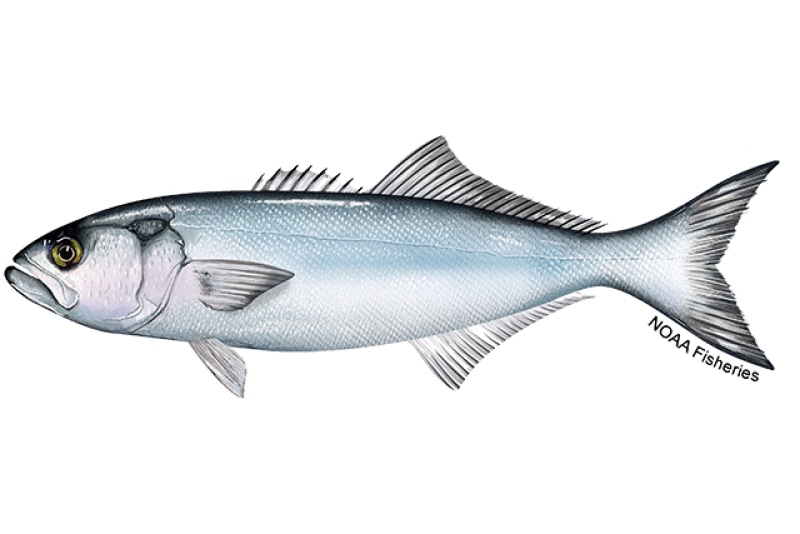
The body is blue-green on the back and silvery on the sides and belly, built long and muscular for sustained pursuit. The identifying equipment is the mouth: NOAA describes razor-sharp teeth and shearing jaws, lined with strong conical teeth that take clean crescents out of bait — and out of careless fingers. Bluefish are taxonomically alone: the sole species of the family Pomatomidae, with no close relatives to confuse them with. Juveniles, widely called snapper blues, are the small striped-silver fish of late-summer estuaries.
Bluefish range along the US East Coast from Maine to eastern Florida and occur in temperate coastal waters worldwide except the eastern Pacific. They are relentless schooling predators — NOAA describes schools grouped by size that can cover tens of square miles — feeding voraciously on squid, menhaden and silversides, and famously eating almost anything they can catch. The spectacle anglers wait for is the blitz, when a school drives baitfish to the surface in churning water. The population migrates north in spring and summer and south in autumn and winter, with juveniles rearing in estuaries and bays.
Interesting Facts About Bluefish
- The only species in its family, Pomatomidae — bluefish have no close relatives.
- NOAA describes them plainly: razor-sharp teeth and shearing jaws.
- They feed voraciously, eating almost anything they can catch.
- Schools grouped by similar-sized fish can cover tens of square miles.
- The bluefish blitz — schools driving bait to the surface — is agency-documented, not angler legend.
Show more facts
- They migrate north in spring and summer, south in autumn and winter.
- Juveniles, known as snapper blues, rear in estuaries and bays.
- The main diet is squid, menhaden and silversides.
- They live up to 12 years and reach up to 31 pounds and 39 inches.
- Recreational anglers account for roughly 83% of the total catch.
- Managed jointly by NOAA Fisheries, the Mid-Atlantic council and the Atlantic States commission.
- The stock is not overfished — rebuilding — and not subject to overfishing.
Average Speed & Size
Most bluefish an angler meets are modest: fish mature around two years old at roughly 15 to 20 inches, and the University of Michigan's zoology database gives an average length of about 30 centimetres while noting the species can reach 120. NOAA puts the maximum at 31 pounds and 39 inches. What the numbers miss is the character. A bluefish fights all the way to the sand — running, shaking and biting at everything including the fish beside it — and a school of even small ones can turn a quiet beach chaotic in minutes.
Where to Find Them
Bluefish are fish of open coastal water and the surf. NOAA maps them along the East Coast from Maine to eastern Florida, moving north in spring and summer and south in autumn and winter, so the calendar decides which end of the range holds fish. Look for high-energy shorelines, surf zones and coastal shelf water, with juveniles inside estuaries and bays. The reliable signal is other species' panic: diving birds and showering bait mark a feeding school better than any electronics. When a blitz starts, the fish are competitive to the point of recklessness.
Bluefish Fishing Tips
Bluefish fishing is fast, rough and hard on tackle — the fish attack moving lures with abandon and cut through unprotected line without slowing. Rig for the teeth first, then find moving water and bait.
Equipment
A medium spinning outfit with 15- to 25-pound line covers most surf and boat fishing, and a wire or heavy fluorocarbon bite leader is essential rather than optional — the teeth are the species' defining equipment. Long-nosed pliers for unhooking protect your fingers; treat every bluefish, of any size, as something that bites.
Chumming
Chumming with cut oily fish works well because bluefish hunt by scent and commotion as much as sight. A steady chum line holds a passing school behind the boat, and once competitive feeding starts, hookups come on almost anything presented.
Bait
Fast-moving lures — metal spoons, topwater plugs, jigs retrieved quickly — match the way bluefish hunt. Cut menhaden or mullet fished in the surf covers the bait side. Replace mangled soft baits often; the teeth destroy them by design.
Patience
Fish the tide and the birds, not the clock. Bluefish arrive with moving water and visible bait, and a beach that is empty at slack can erupt an hour later. When fish are showing, cast into the edge of the school rather than the middle — hooked fish fight cleaner away from the pack.
Conditions that change the bite
- What Barometric Pressure Is Best for Fishing? No research supports a single best barometric pressure for fishing. What pressure really does, how big a weather swing is, and what to watch instead.
- Fishing After Rain: What Runoff Actually Changes Rain rewrites four things at once: clarity, flow, temperature and oxygen. What runoff actually does to the water, which fish it favors, and when to go back.
- Reading River Levels: Fishing by the Gauge More than 13,500 USGS streamgages report stage and flow in near real time. How to read gauge height, cfs and the hydrograph before you drive to the river.
Guides for fishing this species
- Best Conditions for Surf Fishing: Reading Tide, Wind and Swell Together How to read surf fishing conditions as a system — tide, wind and swell together — using official NOAA and NWS data, plus safety guidance for the beach.
- Fishing Line Types: Braid vs Mono vs Fluorocarbon Monofilament, fluorocarbon and braided line compared — stretch, visibility, sink rate and durability, what agencies actually say, and which to spool when.
- Types of Fish: How Species Are Grouped 36,500 species sort four ways: by water, by migration, by family, and by law. A plain map of the types of fish — with every group linked to real profiles.
Related Species
Know when they'll bite.
BiteScore forecasts when bluefish will feed at your spot — from live weather, pressure, and moon data.
Get the App