Summer Flounder
Paralichthys dentatus
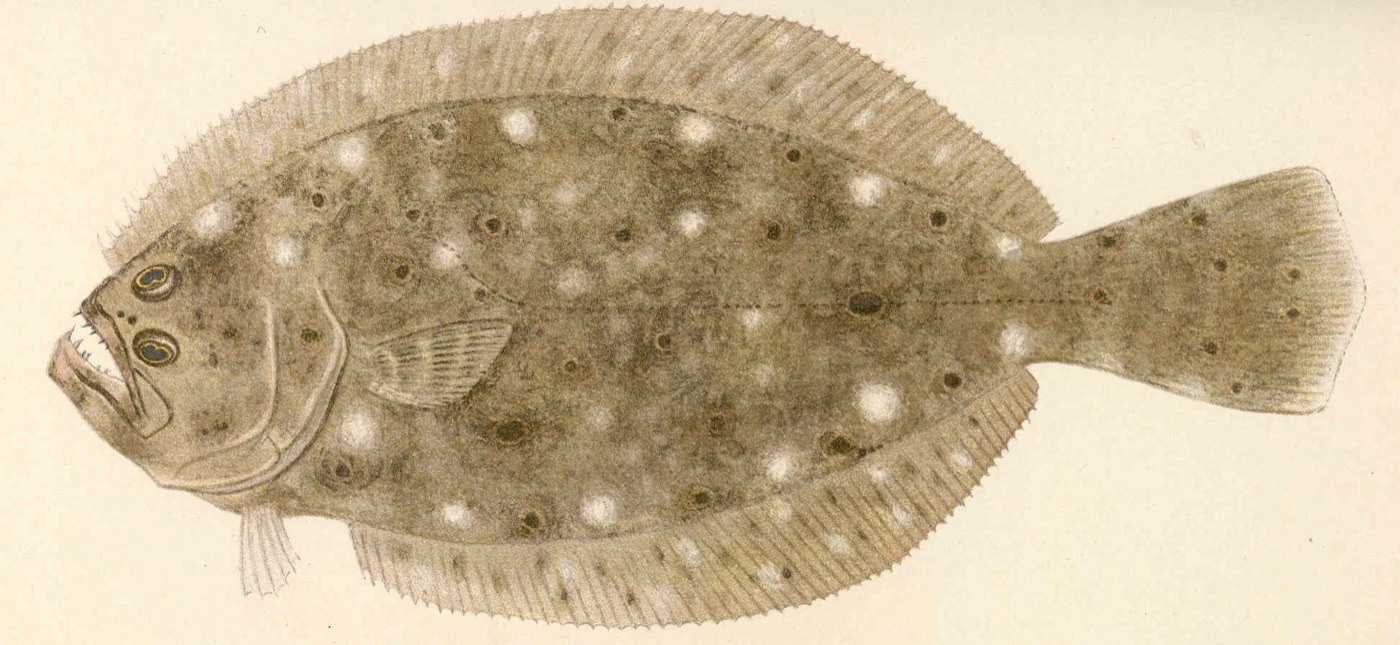
Summer flounder is a flat, left-eyed bottom fish that lies camouflaged on the seafloor with both eyes on the upper side of its body.
MoreFull Species Details
- Species Name
- Paralichthys dentatus
- Family
- Paralichthyidae
- Order
- Pleuronectiformes
- Also Known As
- Fluke, Northern fluke, Flatfish, Doormat
Summer Flounder (Paralichthys dentatus) Fish Description
Summer flounder is a flat, left-eyed bottom fish that lies camouflaged on the seafloor with both eyes on the upper side of its body.
The body is broad, thin, and oval, brown to olive on the eyed side with scattered dark spots and a pale, blind underside. Both eyes sit on the left side of the head, a hallmark of the species that separates it from the right-eyed winter flounder. Large teeth line the wide mouth, marking the summer flounder as an active predator rather than a passive bottom feeder. The fish can rapidly change color and pattern to match sand, mud, or gravel. Lying half-buried, it ambushes prey that passes overhead, then darts up to strike.
Summer flounder is native to the western Atlantic, from Nova Scotia to Florida, and is most abundant from Cape Cod to North Carolina. The species moves inshore into bays and estuaries in the warm months and retreats to deeper offshore waters to spawn in autumn and winter. Summer flounder favor sandy and muddy bottoms near structure and channel edges. Anglers pursue the species for its willingness to strike drifted baits and jigs, the challenge of its subtle bite, and its prized white fillets, which make it one of the most valued inshore food fish.
Interesting Facts About Summer Flounder
- The world record summer flounder weighed 22 pounds 7 ounces, caught off Montauk, New York, in 1975.
- Both of a summer flounder's eyes sit on the left side of its head.
- The species can change color and pattern to match the seafloor in seconds.
- Summer flounder are active ambush predators with large, toothy mouths.
- Larvae begin life symmetrical, and one eye migrates as the fish matures.
Show more facts
- The species moves offshore to spawn in autumn and winter.
- Summer flounder can live up to 20 years, though most are far younger.
- A large female can release several million eggs during a spawning season.
- The species buries in sand with only its eyes exposed to ambush prey.
- Summer flounder are called fluke by most anglers along the US Atlantic coast.
- Trophy fish over 10 pounds are known to anglers as doormats.
- The species supports major recreational and commercial fisheries in the Northeast.
Average Speed & Size
Summer flounder is a bottom-hugging ambush predator that typically reaches 15 to 24 inches and 2 to 5 pounds. Doormats exceed 30 inches and 10 pounds, with the record near 22 pounds. The species lies motionless on the seafloor, then bursts upward in a quick, short strike to seize passing prey. It does not roam or chase over distance, relying instead on camouflage and a sudden lunge, which makes detecting its subtle, weight-like bite the main challenge for anglers.
Where to Find Them
Summer flounder is found on sandy and muddy bottoms in coastal bays, estuaries, and nearshore waters along the US Atlantic coast. The species holds near channel edges, drop-offs, inlets, and structure where current carries bait across the bottom. Summer flounder move inshore in the warm months and offshore to spawn in cold weather, favoring water from the mid-50s to the low 70s Fahrenheit. They lie buried on the bottom awaiting prey. Summer flounder are absent from rocky reefs and warm tropical seas, preferring temperate soft-bottom habitat.
Summer Flounder Fishing Tips
Summer flounder fishing centers on drifting bait along the bottom and detecting a subtle, deliberate bite. Success comes from covering sandy structure with a moving presentation and giving the fish a moment before setting the hook.
Equipment
Use a 6-foot-6 to 7-foot medium spinning or conventional rod with a fast tip, paired with a reel spooled with 15- to 20-pound braid for bottom feel. The sensitive tip is essential to detect the flounder's soft, mouthing bite. Braided line transmits the light take clearly and helps drive the hook past the fish's bony, toothy mouth on the set.
Chumming
Chumming with a mesh bag of ground bait or a strip of cut fish can pull flounder toward a drift lane over sandy bottom. A scent trail on moving current draws buried fish out to intercept passing bait. Many anglers instead tip jigs with strip baits, letting scent and motion together trigger the ambush.
Bait
Live killifish, squid strips, and cut baitfish are the top natural baits, often combined on a bucktail jig. Effective presentations include drifted fluke rigs and jigs bounced slowly along the bottom.
Patience
Summer flounder mouth a bait before committing, so a brief pause before setting the hook prevents pulling it from the fish. Drift steadily over structure and give each take a moment to develop.
Conditions that change the bite
- What Barometric Pressure Is Best for Fishing? No research supports a single best barometric pressure for fishing. What pressure really does, how big a weather swing is, and what to watch instead.
- Fishing After Rain: What Runoff Actually Changes Rain rewrites four things at once: clarity, flow, temperature and oxygen. What runoff actually does to the water, which fish it favors, and when to go back.
- Reading River Levels: Fishing by the Gauge More than 13,500 USGS streamgages report stage and flow in near real time. How to read gauge height, cfs and the hydrograph before you drive to the river.
Guides for fishing this species
- Best Conditions for Surf Fishing: Reading Tide, Wind and Swell Together How to read surf fishing conditions as a system — tide, wind and swell together — using official NOAA and NWS data, plus safety guidance for the beach.
- How to Tie a Dropper Loop The dropper loop in four diagrammed steps — a standing loop mid-line for multi-hook rigs, plus the twist count and the pull that forms it correctly.
- The High-Low Rig: Two Hooks, One Bottom Rig The high-low (double dropper loop) rig explained — how to build it, why two baits beat one on the bottom, and the hook-limit rules that vary by state.
Related Species
Know when they'll bite.
BiteScore forecasts when summer flounder will feed at your spot — from live weather, pressure, and moon data.
Get the App