Sheepshead
Archosargus probatocephalus
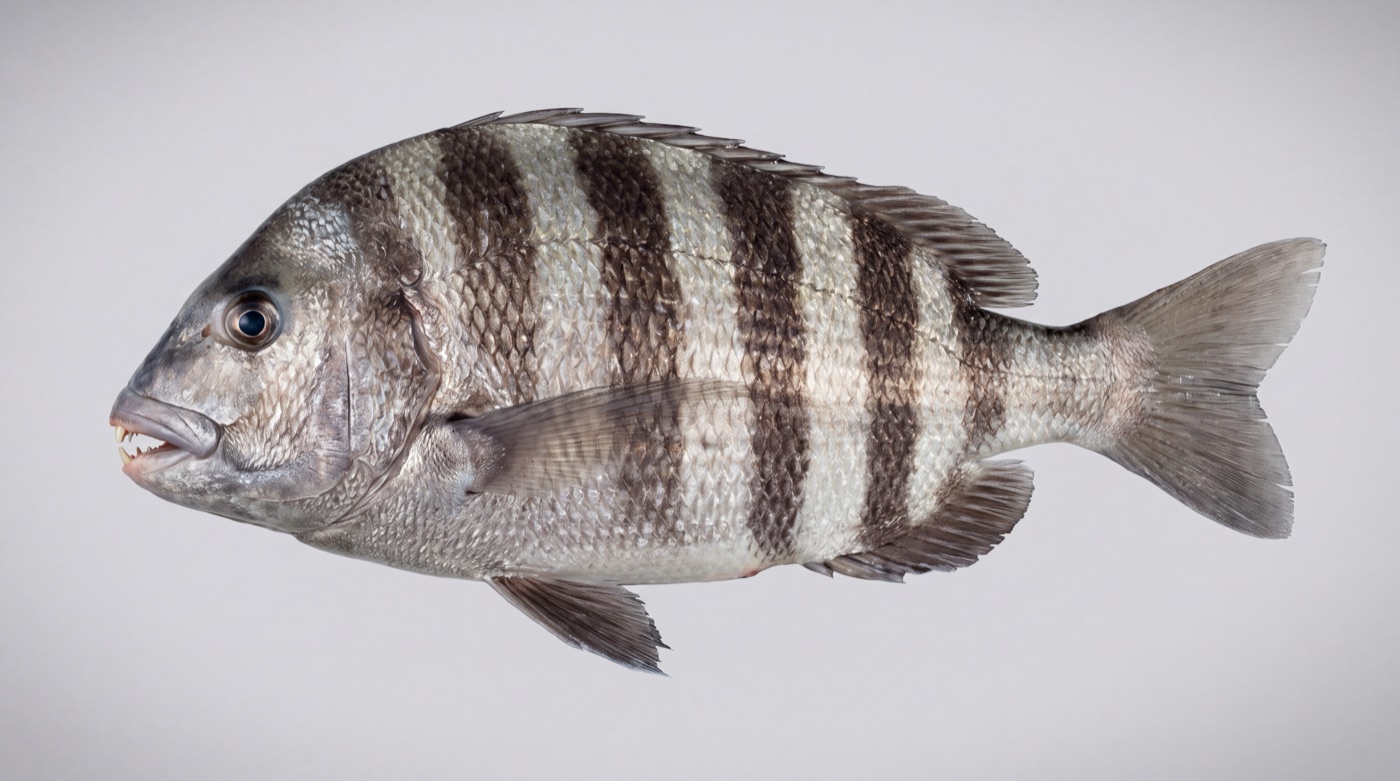
Sheepshead is a stout, deep-bodied member of the porgy family, instantly known by the bold vertical black bars along its flank and the disconcertingly human-looking teeth at the front of its jaws.
MoreFull Species Details
- Species Name
- Archosargus probatocephalus
- Family
- Sparidae
- Order
- Spariformes
- Also Known As
- Convict fish
Sheepshead (Archosargus probatocephalus) Fish Description
Sheepshead is a stout, deep-bodied member of the porgy family, instantly known by the bold vertical black bars along its flank and the disconcertingly human-looking teeth at the front of its jaws.
The body is deep, compressed and silvery-grey, crossed by five or six broad dark bars that earned the species its other name, the convict fish. What sets it apart is the dentition. The front of the jaws carries well-defined incisors, and behind them sit molars arranged in three rows in the upper jaw and two in the lower. The resemblance to human teeth is real enough to unsettle first-time anglers, but the structure is not the same: these are enameloid over dentin rather than enamel, and the enameloid is strengthened by fluorapatite instead of the hydroxyapatite in our own teeth.
Sheepshead range from Nova Scotia to Rio de Janeiro and are euryhaline, tolerating a wide span of salinity and preferring brackish water. They live against hard, encrusted structure — barnacle-covered pilings, jetties, oyster bars, tidal creeks and nearshore wrecks — because that structure is also their food. The whole animal is built around crushing shelled prey, and its teeth have been measured as harder than those of sharks and piranhas. Anglers rate the species highly for the table and notoriously low for the ease of hooking it, since a fish that grazes barnacles is very good at removing a bait without being felt.
Interesting Facts About Sheepshead
- Tooth enameloid measured harder and stiffer than shark and piranha teeth, at 4.36 gigapascals.
- The molars are arranged in three rows in the upper jaw and two rows in the lower.
- The hardness comes from fluoride: the enameloid is strengthened by fluorapatite, not the hydroxyapatite in human teeth.
- The teeth are built to crush shells, not to tear — a different job from a predator's dentition.
- The nickname 'convict fish' comes from the five or six vertical black bars along the body.
Show more facts
- Offshore fish eat mostly sessile invertebrates — bryozoans dominate the diet of fish under 350 mm.
- Larger offshore fish shift toward bivalves, echinoderms and sea squirts.
- Inshore they feed on fiddler crabs, barnacles, oysters, clams and shrimp.
- Studies suggest jaw strength correlates with prey type, from crustaceans to small fish.
- Sheepshead have been aged to 35 years, though 20 years is a more commonly cited maximum.
- They mature between two and five years old, at roughly 7 to 14 inches.
- The species is a Good Choice on the federal EPA and FDA fish advice chart — one serving a week.
Average Speed & Size
Sheepshead are compact rather than large. The Florida Museum gives a common adult length of 14 to 18 inches at 1 to 8 pounds, and Florida's wildlife agency describes the species as common to 13 inches while reaching up to 36. Maximum recorded size is around 29.5 inches and 22 pounds, with the Florida state record at 15 pounds 2 ounces from near Homosassa. This is not a fish that runs. It uses its deep body against structure and dives for the pilings, so the fight is a short, powerful, close-quarters affair decided in the first few seconds.
Where to Find Them
Look for encrusted hard structure and you have found sheepshead: barnacle-covered pilings, jetties, wharves, bridge supports, mangrove roots, oyster bars, tidal creeks and nearshore wrecks and reefs. The connection is direct — the barnacles and small shellfish growing on that structure are what the fish is eating. The Atlantic States Marine Fisheries Commission reports the species in waters warmer than about 60 °F. Fish move toward shore in late winter and early spring to spawn near wrecks and reefs, with juveniles using grassy flats before dispersing to high-relief hard bottom as they mature. Whether sheepshead are genuinely migratory remains unclear.
Sheepshead Fishing Tips
Sheepshead fishing is a bait-presentation problem, not a location problem — the fish are exactly where the barnacles are. The difficulty is that a species evolved to nibble shellfish off a piling can strip a hook without ever registering as a bite.
Equipment
A sensitive medium rod with a fast tip and 15- to 20-pound line is the right compromise: enough sensitivity to feel a subtle bite, enough backbone to turn a fish away from the pilings immediately. Use a small, strong hook — the mouth is hard and the bite is delicate. Abrasion-resistant leader is essential against barnacle-covered structure.
Chumming
Scraping barnacles off pilings into the water is the classic approach, and it works because it is simply serving the fish what it already eats. The scraping brings sheepshead in and gets them competing, which makes the bite far more positive than it otherwise would be.
Bait
Fiddler crabs, shrimp and small crustaceans match the natural diet. Present them tight against structure, because a bait even a foot away from the pilings is in the wrong place.
Patience
Expect to miss fish. The bite is often nothing more than a slight change in weight or a line twitch, so many anglers set the hook when they feel anything unusual at all. Fishing straight down alongside structure keeps a tight line and makes those small signals readable.
Conditions that change the bite
- What Barometric Pressure Is Best for Fishing? No research supports a single best barometric pressure for fishing. What pressure really does, how big a weather swing is, and what to watch instead.
- Fishing After Rain: What Runoff Actually Changes Rain rewrites four things at once: clarity, flow, temperature and oxygen. What runoff actually does to the water, which fish it favors, and when to go back.
- Reading River Levels: Fishing by the Gauge More than 13,500 USGS streamgages report stage and flow in near real time. How to read gauge height, cfs and the hydrograph before you drive to the river.
Guides for fishing this species
- Best Conditions for Surf Fishing: Reading Tide, Wind and Swell Together How to read surf fishing conditions as a system — tide, wind and swell together — using official NOAA and NWS data, plus safety guidance for the beach.
- Fishing Hook Sizes Explained: From #32 to 19/0 How hook sizing really works — numbers down, aughts up — plus hook anatomy, matching size to bait and species, and why agencies push circle and barbless hooks.
- The High-Low Rig: Two Hooks, One Bottom Rig The high-low (double dropper loop) rig explained — how to build it, why two baits beat one on the bottom, and the hook-limit rules that vary by state.
Related Species
Know when they'll bite.
BiteScore forecasts when sheepshead will feed at your spot — from live weather, pressure, and moon data.
Get the App