Dry Fly vs Nymph: Which One, and When
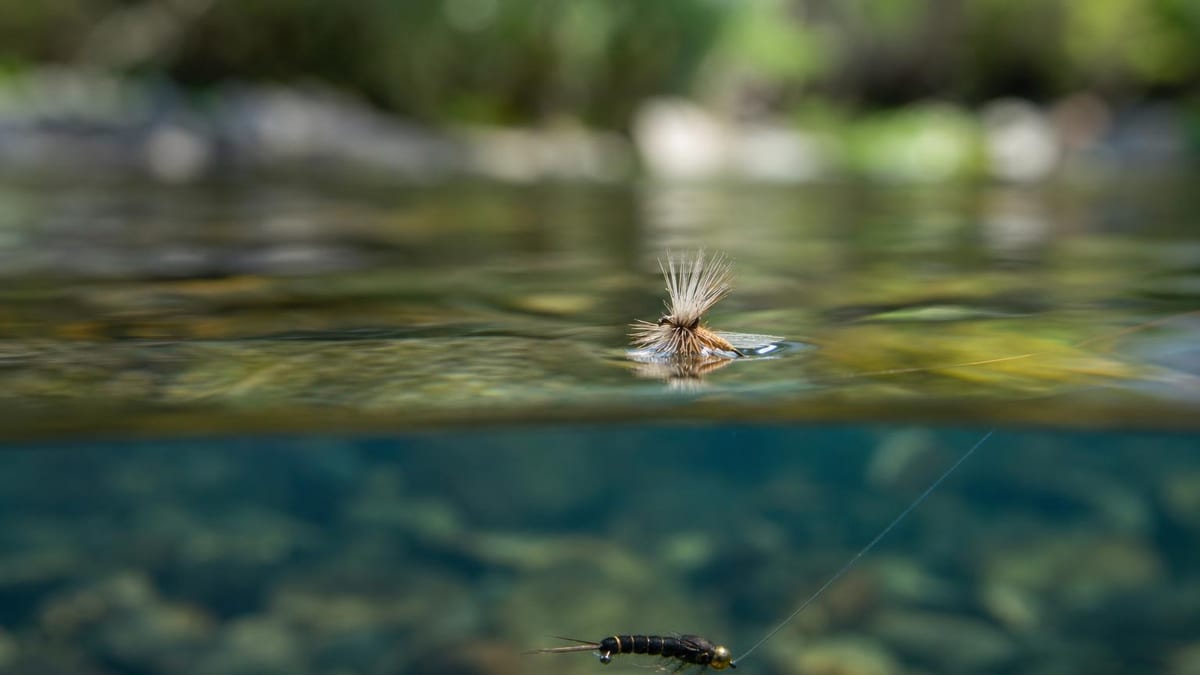
A dry fly floats and imitates the adult insect on the surface; a nymph sinks and imitates the immature stage that lives underwater. Washington's fish and wildlife agency gives the working rule: fish dry patterns when fish are surface feeding, and nymphs or other subsurface patterns when little feeding activity is apparent.
Key takeaways
- Dry flies float and copy adults — mayflies, caddisflies, midges, grasshoppers, ants.
- Nymphs and wet flies copy immature stages and fish below the surface, working best just before a hatch.
- The biology behind it: stoneflies spend 10–11 months as larvae and only 1–4 weeks as adults (Maine DEP).
- Washington's agency rule: dry patterns when fish are surface feeding, subsurface patterns when little activity shows.
- Dry-fly fishing is a two-dimensional game; subsurface fishing is three-dimensional — which is why strike detection is harder below.
- Match the hatch by size, shape and colour — in that order.
Two flies, two worlds
Fly fishing’s oldest argument comes down to a few inches of water. A dry fly floats on the surface film; a nymph sinks beneath it. Take Me Fishing draws the line by life stage: dry flies float on the water’s surface and imitate adult mayflies, caddisflies, midges, grasshoppers, crickets and ants, while nymphs and wet flies represent the immature life stages of insects such as mayflies, caddisflies and stoneflies, fished below the surface.
Most anglers arrive wanting the dry fly. It is the visual, romantic version of the sport — you watch the take. But the fish rarely agree, and the reason is not preference. It is arithmetic.
The biology that settles the argument
Aquatic insects spend the overwhelming majority of their lives underwater, and the numbers come from water-quality science rather than fishing lore. Maine’s Department of Environmental Protection, which samples these insects to monitor stream health, documents the split precisely:
- Stoneflies spend 10 to 11 months as larvae, and only 1 to 4 weeks as adults.
- Mayflies spend most of their lives in larval form; adults live anywhere from 90 minutes to a couple of days, during which they don’t feed at all.
Utah State University Extension generalises it: the immature phases live in the water, then metamorphose and spend the rest of their lives on land — and in many cases macroinvertebrates live in the water for months to several years while being adults for a very short time. The EPA’s stream-monitoring material adds the ecological punchline: these insects are a critical part of the stream’s food web.
Read that as a trout’s menu and the dry-versus-nymph question answers itself. The surface stage is a brief, spectacular event; the underwater stage is the year-round buffet. Take Me Fishing’s qualitative summary matches the biology — sinking flies are more productive overall because gamefish feed most often below the surface. (We publish that as a direction, not a percentage: no government or university source we could verify states a trout-specific figure, and the round numbers that circulate in fishing writing trace to no study.)
One correction worth carrying: not everything down there is a nymph
Anglers call every small subsurface fly a “nymph,” but the insects follow two different scripts, and Maine’s DEP spells out both.
Mayflies and stoneflies undergo incomplete metamorphosis: larvae hatch looking essentially like wingless adults and grow toward adulthood through moults. Their aquatic stage is genuinely a nymph.
Caddisflies undergo complete metamorphosis — a lifecycle Maine’s DEP compares to a butterfly’s: a larval stage, a pupal stage during which metamorphosis occurs, and an adult that looks entirely different. Caddis larvae build an underwater cocoon, live in it as pupae, then emerge, float to the surface or the shore, and finish transforming. So caddis imitations copy larvae and pupae, not nymphs — and that pupal ascent to the surface is exactly the moment a rising fish is eating something that isn’t on top yet.
Knowing which script your local insects follow tells you what to imitate and when. It also explains the fly categories that sit between dry and nymph: emergers represent insects that have reached the surface and are hatching into adults, and wet flies imitate aquatic insects as they swim to the surface. The fourth category is bigger prey entirely — streamers, which represent minnows, sculpins, leeches and other swimming food.
The rule, from an agency
The cleanest decision rule in the verified literature comes from Washington’s Department of Fish and Wildlife: use dry fly patterns when fish are surface feeding, and nymph, leech or other subsurface patterns when little feeding activity is apparent.
Two observations make that rule sharper. Take Me Fishing notes nymphs and wet flies usually work best just prior to a hatch, when the nymphs and pupae they represent become active — the window before any rise appears. And Washington’s agency ties both to weather: insect activity usually rises and falls with temperature, and trout feeding activity seems to do the same. That is the same relationship our water temperature article traces from the fish’s side.
Why dries feel easier and nymphs fish harder
There is a genuine difficulty difference, and Take Me Fishing names it well: once the fly is on the water, fishing a dry fly is a two-dimensional game, while subsurface fishing is three-dimensional. On top, you see the fly, you see the take, and depth is not a variable. Below, you are managing depth, drift and a strike you must detect rather than watch.
That detection problem is why subsurface anglers obsess over contact with the fly — Take Me Fishing notes that uniform-sinking lines provide a straight-line connection to the fly, allowing you to detect a high percentage of strikes. Fly-line choice becomes part of the technique, which our fly line, leader and tippet guide covers, including the sink-tips described as excellent for shallow and deep nymphing.
And you don’t always have to choose. The National Park Service’s Yellowstone fishing regulations describe the arrangement by name: up to two flies may be used on a single leader — “commonly referred to as ‘dropper,’ ‘dry and dropper,’ or ‘hopper and dropper’.” A dry on top, a nymph hanging below it: one rig, both answers. As always, fly and hook counts are set by regulation and vary by water, so check the rules where you fish.
Matching the hatch, practically
Whichever depth you choose, the selection method is the same. Take Me Fishing’s field procedure: if fish are rising, determine what they are eating — get your nose down near the water — then choose a fly similar in size, shape and colour, in that order. Their general framing is the sport’s oldest maxim: match the hatch, using a fly that imitates whatever insects are abundant at your spot.
Washington’s agency explains the cost of ignoring it: when a single type of insect is hatching, trout may be very selective and hard to catch with general patterns or lures. Selectivity is the fish telling you it has narrowed its menu; matching is how you get back on it.
So: watch the water first. Rises mean dry. No rises — the far more common case, and the one the insect biology predicts — means down. And when the hatch is close but hasn’t started, that pre-hatch window is when the nymphs and pupae come alive, and the fish already know it. Our fly fishing basics guide covers the outfit that fishes both, and reading water covers where to put either one for trout that hold in current.
Frequently asked questions
What is the difference between a dry fly and a nymph?
Where they ride and what stage they copy. Take Me Fishing describes dry flies as floating on the water's surface and imitating adult mayflies, caddisflies, midges, grasshoppers, crickets and ants, while nymphs and wet flies represent the immature life stages of insects such as mayflies, caddisflies and stoneflies, fished below the surface. Nymphs are imitations of young insects that live in the water, fished on or near the bottom of lakes and rivers.
When should I fish a nymph instead of a dry fly?
Washington's Department of Fish and Wildlife gives the cleanest rule in the approved literature: use dry fly patterns when fish are surface feeding, and nymph, leech or other subsurface patterns when little feeding activity is apparent. Take Me Fishing adds a timing detail — nymphs and wet flies usually work best just prior to a hatch, when the nymphs and pupae they represent become active. No rises showing? Fish below.
Why do nymphs catch so many fish?
Because that's where the insects spend their lives. Maine's environmental agency documents the arithmetic: stoneflies spend 10 to 11 months as larvae and only 1 to 4 weeks as adults, and adult mayflies live anywhere from 90 minutes to a couple of days without feeding at all. Utah State University Extension frames it generally — immature phases live in the water, then metamorphose and spend the rest of a very short life on land. Take Me Fishing's qualitative summary matches: sinking flies are more productive overall because gamefish feed most often below the surface.
Are all underwater flies called nymphs?
No — and the distinction is real biology. Mayflies and stoneflies undergo incomplete metamorphosis, so their immature aquatic stage genuinely is a nymph. Caddisflies undergo complete metamorphosis: Maine's environmental agency describes a larval stage, a pupal stage inside an underwater cocoon, and an adult that looks entirely different — so caddis imitations copy larvae and pupae, not nymphs. Anglers use 'nymph' loosely for any small subsurface fly; the fly box doesn't mind, but the insects do.
What does 'match the hatch' actually mean?
Using a fly that imitates whatever insects are abundant where you're fishing. Take Me Fishing's practical method: if fish are rising, work out what they're eating — get your nose down near the water — then choose a fly similar in size, shape and colour, in that order. Washington's agency adds the warning that makes it matter: when a single type of insect is hatching, trout may be very selective and hard to catch with general patterns.
Sources
- Beginner Fly Categories — Take Me Fishing (Recreational Boating & Fishing Foundation). Accessed August 16, 2026.
- Best Fishing Flies — Take Me Fishing (Recreational Boating & Fishing Foundation). Accessed August 16, 2026.
- Surface Fly Fishing Techniques — Take Me Fishing (Recreational Boating & Fishing Foundation). Accessed August 16, 2026.
- High lakes fishing — Washington Department of Fish & Wildlife. Accessed August 16, 2026.
- Mayfly Larvae (Ephemeroptera) — Maine Department of Environmental Protection. Accessed August 16, 2026.
- Stonefly Larvae (Plecoptera) — Maine Department of Environmental Protection. Accessed August 16, 2026.
- Caddisfly Larvae (Trichoptera) — Maine Department of Environmental Protection. Accessed August 16, 2026.
- Water Quality Impacts on Aquatic Macroinvertebrates — Utah State University Extension. Accessed August 16, 2026.
- Fishing regulations — National Park Service, Yellowstone National Park. Accessed August 16, 2026.
How we choose sources: sources policy.
More in this series
Know when it's worth going.
Fishing Club AI turns live weather, pressure and moon data into a simple bite forecast for your spot — so the skills you practise get used on the right day.
Get the App