What Is the Best App for Identifying Fish From a Photo?
Photo identification apps run a computer-vision model trained on labelled images, and they return a most-likely species with a confidence figure — not a determination. The published work shows how demanding the training is: one USGS dataset assembled 37,000 annotated underwater images for a single species. Accuracy in the field depends on photo quality, angle and how similar the local look-alikes are, and no app's result decides whether a fish is legal to keep. That call belongs to your state agency.
Key takeaways
- A photo ID model returns a probability ranking, not an identification. Confidence is the model's, not a guarantee.
- Training data is the expensive part: one USGS dataset comprises 37,000 high-resolution underwater images of a single invasive species, captured by autonomous underwater vehicles.
- Misidentification is not only a machine problem. USGS has published research on fish misidentification by monitoring programmes in the San Francisco Estuary.
- Model performance degrades on low-resolution imagery, which is exactly what a wet phone photo in bad light often is.
- No identification app determines legality. Size and bag limits, closed seasons and protected species come from your state agency.
What the app is actually doing
A photo identification tool is a classifier. Someone assembled a large set of images, labelled each one by species, and trained a model to recognise the visual features that separate them. When you submit a photo, the model ranks candidate species and returns the most likely one, usually with a confidence number.
Two things follow from that description, and both are routinely lost in the marketing.
It returns a probability, not a fact. A confidence figure describes how strongly the photo matches patterns in the training data. It is not a statement about the fish.
It only knows what it was trained on. Species absent from the training set cannot be returned, and species poorly represented will be returned badly.
The training data is the hard part
The scale of annotation involved is easy to underestimate. One US Geological Survey dataset consists of 37,000 high-resolution images of natural lake bottom habitat containing round goby, an invasive species in the Laurentian Great Lakes, captured by autonomous underwater vehicles between 2020 and 2023 and annotated to support deep learning.
That is one species, in one system, for a research application. It is the clearest available illustration of why identification models are good at common, well-photographed species and unreliable on regional look-alikes nobody has assembled a dataset for.
Government science uses the same technology on the same terms. NOAA Fisheries has run video surveys in the Gulf of Mexico for over thirty years and has published work on using machine learning to speed up the analysis; USGS applies it across its Ecosystems Mission Area. In both cases the model accelerates the work and scientists verify the output.
Where identification breaks down
| Failure mode | Why it happens | What to do |
|---|---|---|
| Poor image quality | Documented weakness of existing methods is degraded performance at lower resolution | Reshoot: fill the frame, even light, fish side-on |
| Close look-alikes | Species separated by fin rays, mouth position or tooth patches, not overall shape | Photograph the head and tail separately |
| Unusual angle | Training images are mostly lateral views | Avoid the downward foreshortened shot |
| Regional species | Local species may be thin or absent in training data | Cross-check against a field guide for your state |
| Juveniles and hybrids | Colouration and proportions shift with age; hybrids blend features | Treat any result as provisional |
It is worth saying that this is hard for people too, not just software. USGS has published research on fish misidentification and its implications for monitoring within the San Francisco Estuary — in a programme run by trained observers. If you get a confusing result on a difficult pair, the confusion is in the fish, not only in the app.
The line no app should cross
An identification does not decide whether you may keep a fish.
Size limits, bag limits, closed seasons, protected species and slot rules are set by state agencies, differ by water body, and change during the season through emergency rules. Two species that a model may confuse can carry completely different rules on the same lake.
So the correct workflow is: identify, then verify against the agency for the water you are standing on. Our licences and regulations guide explains where to look, and it links to agencies rather than restating rules, deliberately.
Any app that presents an identification as though it settles the legal question is doing something worse than being inaccurate.
What we do
Our photo identification feature returns a most-likely species with the field-guide entry attached, so you can check the distinguishing features yourself rather than taking the label on trust. It does not make legal determinations, and it says so where it matters.
The mechanism, including what the model can and cannot infer from a single frame, is in how AI fish identification works.
How to choose one
Submit the same photo to any candidate app and look at three things: whether it shows alternatives and a confidence figure, whether it explains what separates the top candidates, and whether it routes you to a regulatory authority rather than implying one.
A tool that shows its uncertainty is more useful on the water than one that sounds certain, because the fish you actually need help with are the ambiguous ones.
What it cannot do
- This page cannot rank identification apps: no independent test compares them on real angler photos.
- Reported accuracy figures generally come from curated datasets under controlled conditions and do not transfer directly to a fish held at arm's length in the rain.
- Close look-alikes are where every model struggles, and they are exactly the pairs where regulations often differ.
- We offer photo identification ourselves, and it carries the same constraints — a most-likely species, never a legal determination.
Frequently asked questions
What is the best app for identifying fish from a photo?
No independent test ranks them, so treat any list as opinion. What separates a good identification tool from a weak one is observable without a test: does it show a confidence figure and alternative candidates rather than a single confident answer, does it explain the features that distinguish look-alikes, and does it point you to your state agency for regulations rather than implying the identification settles legality. A tool that returns one species name with no alternatives is hiding its uncertainty.
How does fish identification from a photo actually work?
A model is trained on many images that people have labelled by hand, learns the visual features that separate species, and then ranks candidates for a new photo. The labelling effort is substantial: one US Geological Survey dataset consists of 37,000 high-resolution images of lake-bottom habitat containing a single invasive species, round goby, captured by autonomous underwater vehicles in the Great Lakes between 2020 and 2023. That scale of annotation is what a working model requires.
How accurate is fish identification from photos?
It depends heavily on the photo and the species, and published figures usually come from controlled datasets rather than angler snapshots. Documented weaknesses of existing methods include degraded performance at lower resolution — which is what a wet, poorly lit phone photo often is. Identification is also genuinely hard for humans: USGS has published research on fish misidentification within San Francisco Estuary monitoring, so a difficult call is difficult for everyone.
Can a fish ID app tell me if I can keep the fish?
No, and treating it as though it can is the real risk in this category. Regulations are set by state agencies and vary by water body, season, species and sometimes by individual reservoir. They also change mid-season through emergency rules. An identification is an input to that decision, not the decision. Check your state fish and wildlife agency for the water you are standing on, every trip.
How do I take a photo that identifies well?
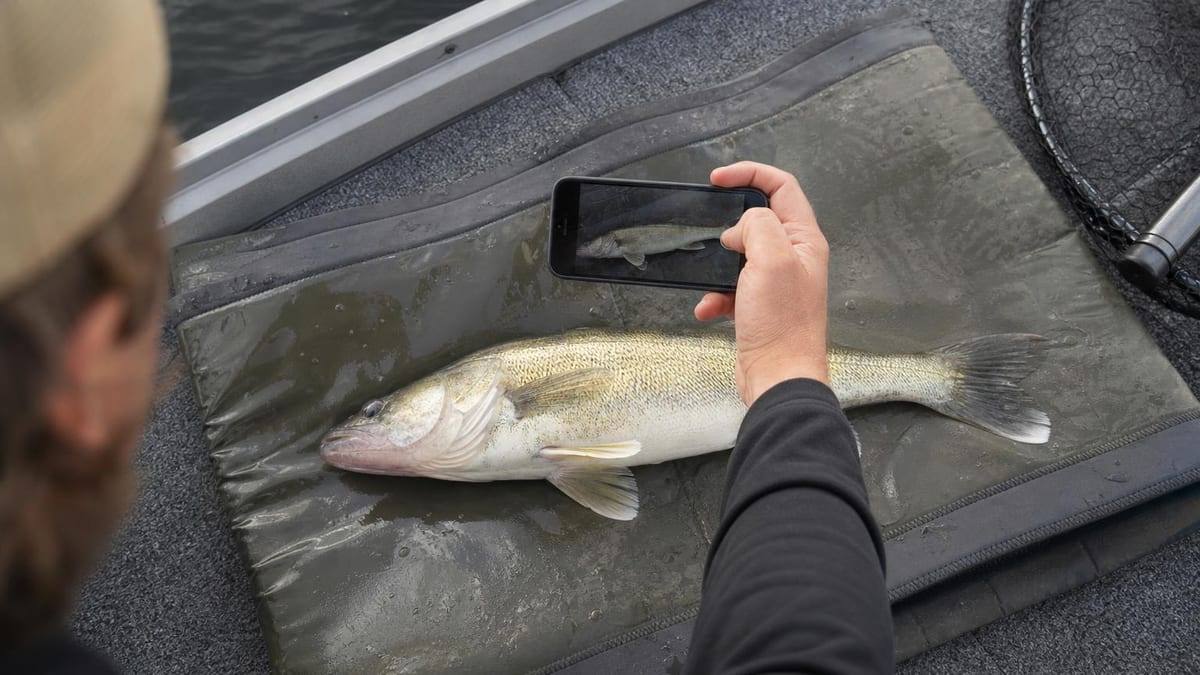
Give the model what it was trained on. Photograph the whole fish side-on, filling the frame, in even light rather than harsh sun or shadow. Keep fins spread if you can, keep the fish wet, and avoid the downward angle that foreshortens the body. If the result is uncertain, take a second frame of the head and one of the tail — mouth position and fin ray detail separate many look-alike pairs.
Related reading
Sources
- Annotated underwater images of round goby (Great Lakes, 2020-2023) to support deep learning — US Geological Survey. Accessed August 16, 2026.
- Fish misidentification and potential implications to monitoring within the San Francisco Estuary — US Geological Survey. Accessed August 16, 2026.
- Artificial Intelligence in the USGS Ecosystems Mission Area — US Geological Survey. Accessed August 16, 2026.
- Increasing Efficiency of Video Surveys with Artificial Intelligence — NOAA Fisheries. Accessed August 16, 2026.
- Fish species identification on low resolution: enhanced super-resolution approaches — Scientific Reports / PubMed Central (PMC12192931). Accessed August 16, 2026.
How we choose sources: sources policy.
More in this series
See the conditions for your own spot.
Fishing Club AI turns live weather, pressure and moon data into an hourly forecast — and shows you which factors moved the number.
Get the App