Walleye
Sander vitreus
Walleye is a large freshwater predator of the perch family, named for its cloudy, reflective eyes that let it hunt in low light.
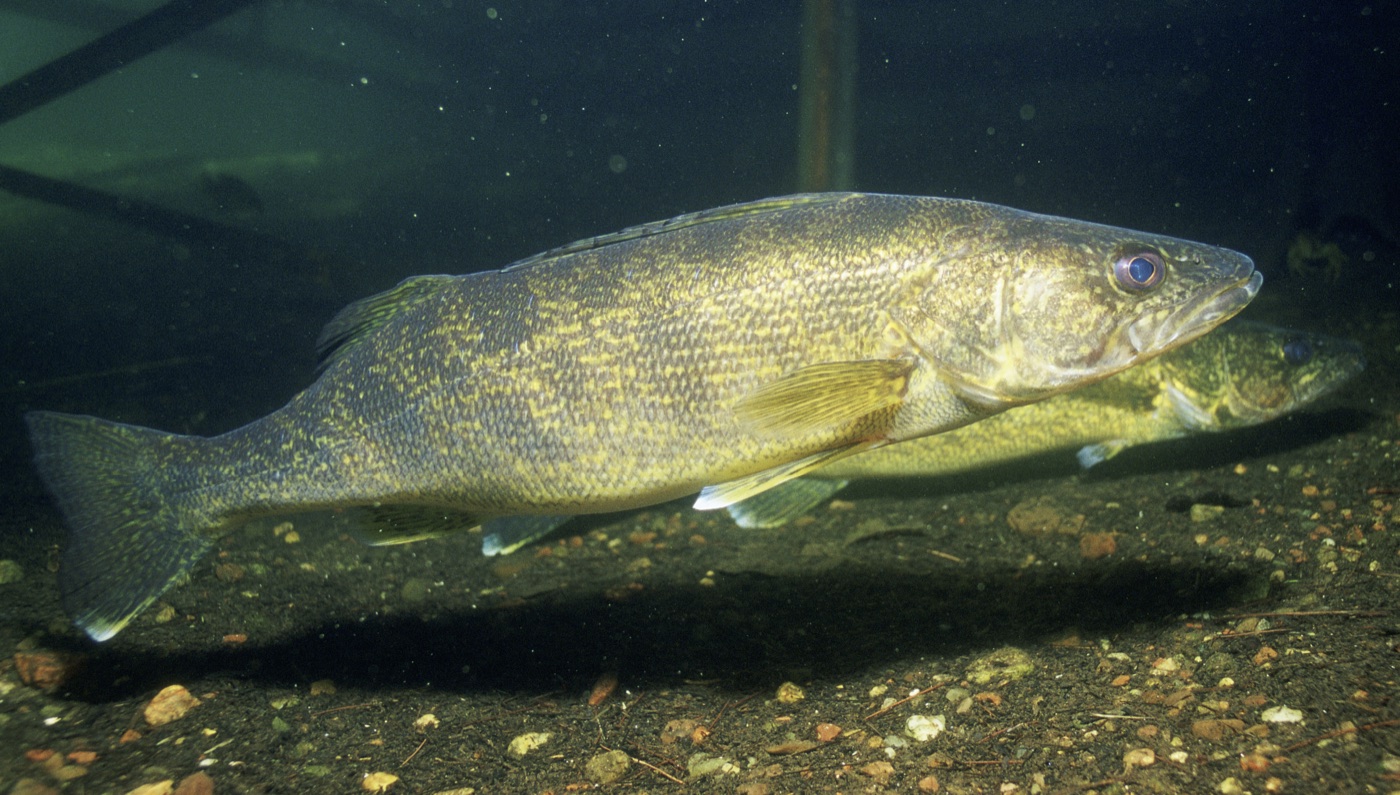
MoreFull Species Details
- Species Name
- Sander vitreus
- Family
- Percidae
- Order
- Perciformes
- Also Known As
- Walleyed pike, Yellow pickerel, Pickerel, Marble eyes
Walleye (Sander vitreus) Fish Description
Walleye is a large freshwater predator of the perch family, named for its cloudy, reflective eyes that let it hunt in low light.
The body is long and cylindrical, olive-gold to brassy on the back with a white belly and dark saddles across the flanks. The defining feature is the eye: a reflective layer called the tapetum lucidum gives it a glassy, marbled look and superb vision in dim water. The mouth holds rows of sharp teeth, and the first dorsal fin bears strong spines. A white patch on the lower tail lobe distinguishes the walleye from the similar sauger. Its coloration lets the fish blend into stained or tannic water where it hunts.
Walleye is native to the northern United States and much of Canada, from the Great Lakes basin across the northern plains. Extensive stocking has extended its range south and west into countless reservoirs and rivers. The species thrives in large, cool lakes and slow rivers with some turbidity. Anglers pursue walleye for two reasons above all: the fish yields firm, mild, highly regarded fillets, and locating light-sensitive fish that feed at dawn, dusk, and night makes for an absorbing technical challenge.
Interesting Facts About Walleye
- The world record walleye weighed 25 pounds, caught in Tennessee in 1960.
- Walleye can live more than 20 years in cold northern lakes.
- The reflective tapetum lucidum lets walleye see and feed in near darkness.
- Walleye feed most actively at dawn, dusk, and after dark.
- The species spawns in early spring over gravel and rocky shoals.
Show more facts
- A large female walleye can release more than 500,000 eggs in one season.
- Walleye avoid bright sunlight and move deeper as the sun rises.
- The species is the official state fish of Minnesota, South Dakota, and Vermont.
- Walleye grow slowly, and trophy fish over 10 pounds are typically decades old.
- Wind that stirs shallow water, known as a walleye chop, triggers feeding.
- Walleye and the smaller sauger can interbreed to produce a hybrid called a saugeye.
- The species prefers water temperatures between 65 and 75 degrees Fahrenheit.
Average Speed & Size
Walleye is a moderate, methodical swimmer that typically reaches 14 to 24 inches and 1 to 6 pounds. Trophy fish exceed 30 inches and 10 pounds, with the largest approaching 25 pounds. The species relies on stealth and low-light vision rather than speed, drifting slowly along bottom structure before a short lunge at prey. Walleye hold near the lake floor by day and rise into shallower water to feed as light fades.
Where to Find Them
Walleye is found in large, cool lakes, reservoirs, and slow rivers across the northern United States and Canada. The species holds along drop-offs, rocky points, gravel bars, and weed edges, moving shallow to feed in low light. Walleye favor water between 65 and 75 degrees Fahrenheit and often relate to some turbidity or wind-driven current that dims the light. In clear lakes they retreat to deeper water by day. Walleye are largely absent from warm southern ponds and small, clear headwater streams, which lack the cool, open water the species needs.
Walleye Fishing Tips
Walleye fishing is technical and timing-driven, which is part of its appeal. Success depends on fishing the low-light windows and presenting bait slowly along the bottom where walleye hold.
Equipment
Use a 6-foot-6 to 7-foot medium-light spinning rod with a fast tip, paired with a reel spooled with 6- to 10-pound monofilament or braid to a fluorocarbon leader. The sensitive tip is essential for detecting the walleye's famously light, subtle bite. A slightly stiffer backbone drives the hook past the fish's bony mouth on the set.
Chumming
Chumming is uncommon for walleye; anglers instead use controlled presentations along bottom structure. Trolling crankbaits or drifting live-bait rigs at slow speed covers water until a school is located. Once fish are found, vertical jigging keeps the bait in the strike zone through the low-light feeding window.
Bait
Live minnows, nightcrawlers, and leeches are the top natural baits, often fished on a jig or bottom rig. Effective lures include jigs tipped with plastic, slow-trolled crankbaits, and bladed spinner rigs.
Patience
Walleye bite lightly and feed in narrow low-light windows, so a slow, deliberate presentation and close attention to the line matter more than fast coverage. Set the hook on the faintest tick.
Conditions that change the bite
- What Barometric Pressure Is Best for Fishing? No research supports a single best barometric pressure for fishing. What pressure really does, how big a weather swing is, and what to watch instead.
- Fishing After Rain: What Runoff Actually Changes Rain rewrites four things at once: clarity, flow, temperature and oxygen. What runoff actually does to the water, which fish it favors, and when to go back.
- Reading River Levels: Fishing by the Gauge More than 13,500 USGS streamgages report stage and flow in near real time. How to read gauge height, cfs and the hydrograph before you drive to the river.
Guides for fishing this species
- Walleye Fishing: Light, Depth and a Slow Retrieve Walleye eyes are built for low light, which sets where they sit and when they feed. What that means for depth, timing and how slowly you fish.
- Fishing Licenses: How the System Works and Where the Money Goes License sales plus excise taxes fund fisheries through a user-pays system dating to 1950. How the Sport Fish Restoration program works and why licenses matter.
- How to Choose Lure Colour Water absorbs red light first and blue last, so lure colour changes with depth and clarity. How to choose for visibility instead of guessing from folklore.
- How to Tie a Palomar Knot The Palomar knot in four steps, why it suits braided line, the three mistakes that weaken it, and when a different knot is the better choice.
- How to Tie a Surgeon's Knot The surgeon's knot in five diagrammed steps — the fastest reliable way to join two lines, and the join that forgives different diameters.
- How to Tie a Uni Knot The uni knot in five diagrammed steps — one tying motion that handles hooks, lures, line joins and the reel spool, and why it earns the name 'uni'.
Related Species
Know when they'll bite.
BiteScore forecasts when walleye will feed at your spot — from live weather, pressure, and moon data.
Get the App