How to Fly Cast: The Basic Overhead Cast
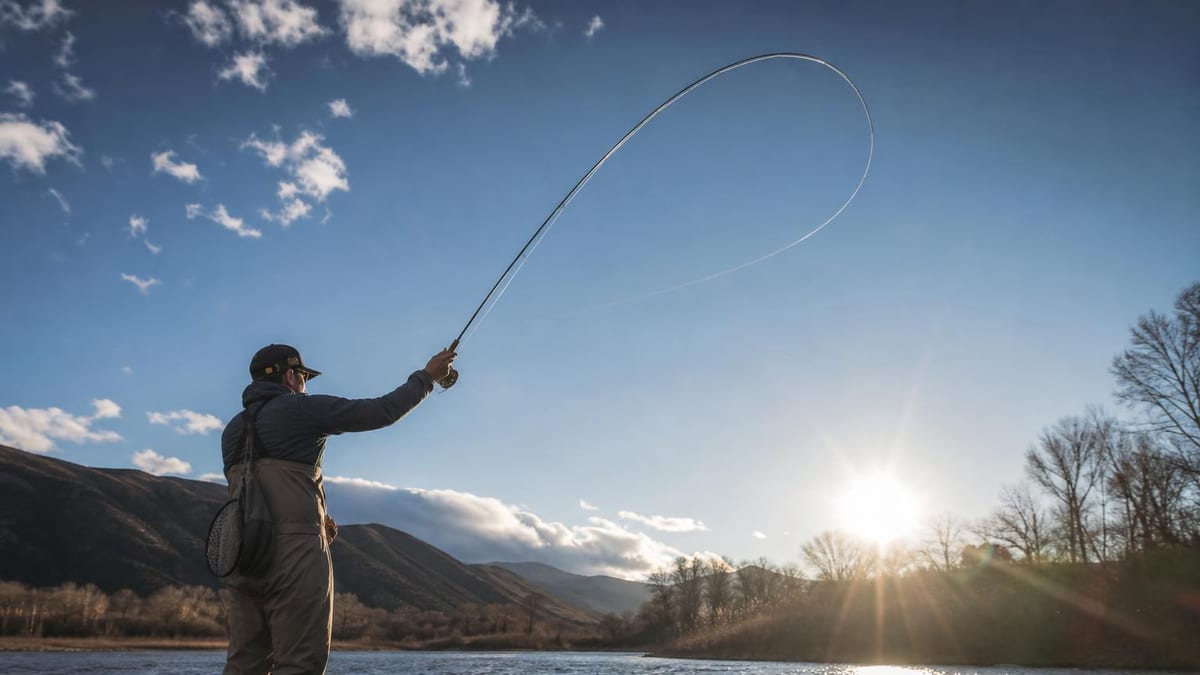
Texas Parks and Wildlife teaches the standard fly cast in four parts: pick up, back cast, forward cast, lay down — blended into one smooth motion. The move that makes it work is the pause at the end of each stroke, long enough for the line to straighten behind you before you come forward.
Key takeaways
- Four parts, one motion: pick up, back cast, forward cast, lay down.
- Pause at the end of each stroke — its length depends on how much line is in the air.
- Aim for tight, narrow 2- to 3-foot loops on both the back cast and the forward cast.
- Grip it like a handshake with your thumb on top: the line goes where your thumb points.
- Practice on grass with a piece of bright yarn instead of a fly — a state angler-education instruction, not a shortcut.
- Silence is the tell: most good casts are virtually silent; whistling or cracking means something is wrong.
Four parts, one motion
State angler education teaches the fly cast as a sequence, and Texas Parks and Wildlife’s student guide names the parts in order: pick up, back cast, forward cast, lay down — with the instruction that matters most attached: try to blend the individual movements into one smooth casting motion. Four labels, one gesture.
Before any of them, set the platform. TPWD’s instructor guide keeps it simple: stand facing your target, grip the rod as though shaking hands with it, thumb on top of the handle, grip relaxed but firm. Their beginner guide adds the reason the thumb matters — the line will go in the direction your thumb points.
1. Pick up
Get the line moving without ripping it. TPWD describes the pick-up as raising the rod tip continuously, but relatively slowly, until most of the fly line is off the ground or out of the water. Their student guide frames the same move as gently and slowly lifting the rod to about a 45-degree angle. You are peeling line off the surface, not tearing it.
2. Back cast
Now accelerate — and stop. TPWD’s instructor guide: accelerate the back cast, stopping abruptly when your hand is beside your ear, keeping the wrist straight; the student guide describes snapping the rod with some force to just past vertical and stopping quickly. That abrupt stop is not a detail: it is what makes the line form a loop and travel.
3. Pause — the part nobody teaches loudly enough
The pause is not between steps 2 and 3; it is the cast. TPWD’s instructor guide states the principle and the variable in two sentences: “There must be a pause at the end of each stroke. The length of the pause depends on how much line you have in the air.” Then: pause long enough to allow the line to straighten out behind you.
Their student guide gives the beginner’s trick for learning it: turn your head and watch the line straighten out and up — the line must straighten before moving to the forward cast. The beginner guide adds the tempo instruction: as the loop opens and the line becomes nearly straight behind you (don’t rush it), begin your forward cast.
4. Forward cast and lay down
Come forward with the same acceleration-then-stop, finishing, per TPWD, with an abrupt stop at about the same 45-degree angle where the back cast began — thumb at roughly 10 o’clock or about 45 degrees above the water. Then let it settle: pause, allow the fly line to unfold in front of you, and follow the line down to the water with the rod tip.
If the line splashes, TPWD names the two causes: you aimed too low, or the forward cast wasn’t delivered in one smooth action.
About the clock: agencies use it, and they disagree
You will hear “ten and two” repeated as though it were physics. It is a teaching picture, and the approved sources genuinely differ on the numbers.
- National Park Service: picture your arm on a clock — neutral is 12 o’clock, forward during the cast is 10 o’clock, and the back cast is 2 o’clock.
- TPWD instructor guide: stop the back cast when your hand is beside your ear, at about 1 o’clock.
- TPWD beginner guide: stop the forearm when the rod reaches just past 12 o’clock.
- TPWD student handout: no clock at all — lift to about 45 degrees, snap to just past vertical, stop the forward cast at about 45 degrees.
Four agency publications, four framings. What every one of them shares is the abrupt stop and the straight-line path of the rod tip, not any particular hour. Use whichever picture helps your arm; don’t defend the numbers.
Loops: the feedback your cast gives you
TPWD’s instructor guide sets the target plainly: form tight, narrow 2- to 3-foot loops on both the back cast and the forward cast. It also explains where loop shape comes from — to form the most efficient, least air-resistant loops and direct the cast’s energy at a target, the caster must move the rod tip in a straight line — and where the line ends up: the line and fly go in the direction of the rod tip at the end of the forward cast, the “stop” position.
Bad loops diagnose themselves:
- Wide loop — the rod tip followed a convex, dome-shaped path: low, then rising, then falling. The higher the curve, the wider the loop.
- Tailing loop (line crossing or colliding with itself) — the rod tip followed a concave path, dipping in the middle, or the caster stopped short on the back or forward cast.
- Wind knots — TPWD attributes these to poor casting technique, not wind.
- Noise — most good casts are virtually silent; a whistle or crack means something is wrong. The Park Service’s version: don’t use the rod like a whip, because sudden, sharp casts snap the fly off the leader or scare fish.
One more control that costs nothing: TPWD notes the stroke length must vary with how much line is past the rod tip — short line out, short stroke — and that slack line should be kept to an absolute minimum.
Your other hand has a job
The line hand is not a passenger. TPWD’s instructor guide: your non-dominant hand holds the fly line but follows the cast, ensuring there is no slack and that tension is maintained; hold the line between thumb and forefinger, comfortably in front of the body.
It also delivers distance. To shoot line, TPWD’s instruction is to release line at the moment of the abrupt stop on the forward cast, with a well-formed loop already travelling.
And when a fish eats, the line hand sets the hook. The Park Service describes the strip set: pull on the line with your free hand once a fish bites — a single, hard tug while keeping the rod motionless. Missouri’s agency describes the retrieve that precedes it for streamers: strip the fly back toward you as it flows downstream and across the stream.
False casting and the roll cast
False casting is casting without landing the fly. TPWD defines it as a series of backward and forward casts made entirely in the air, used to increase line length or change direction — execute the four-part cast but don’t return the line to the water, beginning each new false cast as soon as the previous forward loop has straightened. On the final cast, stop the rod in the proper position, let the loop form, and follow the line down with the rod tip. Use it with purpose: line in the air is line not fishing.
The roll cast solves the problem of a wall of trees behind you. TPWD: it is useful when space for a back cast is limited, and it is necessary to lift a sunken fly line to the surface before making a standard back cast. The mechanism is unusual — the cast must be made with line floating on the water, because it is the surface tension gripping the fly line that makes it possible. Their sequence: raise the rod slowly to slightly beyond vertical so the line slides toward you; tilt the rod slightly outward so the line forms a belly behind your shoulder; when the line stops sliding, lower the elbow slightly and make a standard forward cast motion. The line makes a rolling loop and falls lightly on the surface. It is the cast for brushy small streams — the same tight water our reading water guide sends you into.
Practice: on grass, with yarn
The single most agency-endorsed piece of advice about learning to cast has nothing to do with water. TPWD’s beginner guide instructs: do not have a fly tied on for practice; tie on a piece of bright coloured yarn. Yarn appears in their instructor equipment list too, and the student guide’s practice drill is to make one cast at a time, letting the line land in front of you each time.
A lawn works because the cast is about line, not water. TPWD’s course-management note also gives a useful safety margin for anyone practising near others: their class layout allows about 40 feet in front and behind each caster and about 15 feet between pairs. A hook-free yarn tip removes most of the remaining risk — and Missouri’s agency supplies the honest framing for the whole exercise: you cannot become an accomplished fly angler by reading. It is learned by doing.
Once the loop starts unrolling on its own, the rest of fly fishing is choices rather than mechanics: the outfit, the line and leader that carry your fly, and whether the fish want it on the surface or underneath.
Frequently asked questions
What are the steps of a basic fly cast?
Texas Parks and Wildlife's angler education course teaches a four-part overhead cast: 1) pick up — raise the rod tip continuously but relatively slowly until most of the line is off the ground or water; 2) back cast — accelerate and stop abruptly with the rod near vertical; 3) forward cast — after the pause, accelerate forward and stop abruptly at about 45 degrees; 4) lay down — follow the line down with the rod tip. Their instruction is to blend the individual movements into one smooth casting motion.
Is the fly cast really a '10 and 2 o'clock' motion?
The clock analogy is taught by agencies, but they don't agree on the numbers — so treat it as a picture, not a rule. The National Park Service describes 12 o'clock as neutral, 10 o'clock forward and 2 o'clock on the back cast. Texas Parks and Wildlife's instructor guide stops the back cast at about 1 o'clock with the hand beside the ear, and its beginner guide says just past 12 o'clock; the student handout drops clocks entirely and uses degrees — up to about 45 degrees, back to just past vertical, forward to a stop at about 45 degrees. What all of them share is the abrupt stop, not a specific hour.
Why does my fly line crack like a whip?
Because you're not pausing. Texas Parks and Wildlife's instructor guide is direct: most good casts are virtually silent, and if you hear a whistling or cracking sound you're having difficulty with the cast. The fix is the pause — the line must straighten behind you before the forward stroke starts. The National Park Service adds the same caution from the other end: don't use the rod like a whip, because casts that are too sudden and sharp will snap the fly off the leader or scare fish.
What is false casting for?
Changing length or direction without putting the fly down. Texas Parks and Wildlife defines it as a series of backward and forward casts made entirely in the air, used to increase the length of line or change the cast's direction — you simply don't return the line to the water after the forward cast, and begin each false cast as soon as the previous loop has straightened. On the final cast you stop the rod in position, let the loop form, and follow the line down with the rod tip. Use it deliberately: every false cast is time your fly isn't fishing.
What is a roll cast and when do I need one?
It's the cast for when there's no room behind you. Texas Parks and Wildlife notes the roll cast is useful when space for a back cast is limited, and is also needed to lift a sunken line to the surface before a standard back cast. It only works with line on the water — the surface tension gripping the line is what makes the cast possible. Raise the rod slowly to slightly beyond vertical so the line slides toward you, tilt the rod outward so the line forms a belly behind your shoulder, then make a standard forward cast: the line rolls out in a loop and falls lightly on the surface.
Sources
- Basic and Intermediate Fly Fishing — Instructor Guide — Texas Parks & Wildlife Department. Accessed August 16, 2026.
- Basic and Intermediate Fly Fishing — Student Guide — Texas Parks & Wildlife Department. Accessed August 16, 2026.
- Fish Texas: A Basic Guide for the Beginning Angler — Texas Parks & Wildlife Department. Accessed August 16, 2026.
- Fly fishing — National Park Service. Accessed August 16, 2026.
- Fly Fishing — Missouri Department of Conservation. Accessed August 16, 2026.
- How to Cast a Fly Rod — Take Me Fishing (Recreational Boating & Fishing Foundation). Accessed August 16, 2026.
- Roll Casting Technique — Take Me Fishing (Recreational Boating & Fishing Foundation). Accessed August 16, 2026.
How we choose sources: sources policy.
More in this series
Know when it's worth going.
Fishing Club AI turns live weather, pressure and moon data into a simple bite forecast for your spot — so the skills you practise get used on the right day.
Get the App